
Touch Screen Laptops: Factors To Consider For Performance, Display, And Battery Life

Performance Components and Thermal Considerations for Touch Screen Laptops
Processors, memory, and storage form the core performance profile of a touch screen laptop. Modern mobile processors vary by architecture and power envelope; those with lower thermal design power (TDP) are common in thin convertibles to limit heat and extend battery life. RAM capacity and speed affect multitasking and application responsiveness; systems with higher RAM may sustain more background processes without swapping. NVMe SSDs typically provide faster sequential and random access than older SATA drives, improving application launch times. Designers often tune clocking and cooling to balance short-term burst performance and sustained workloads, so benchmark figures may reflect specific thermal behaviors rather than absolute capability.
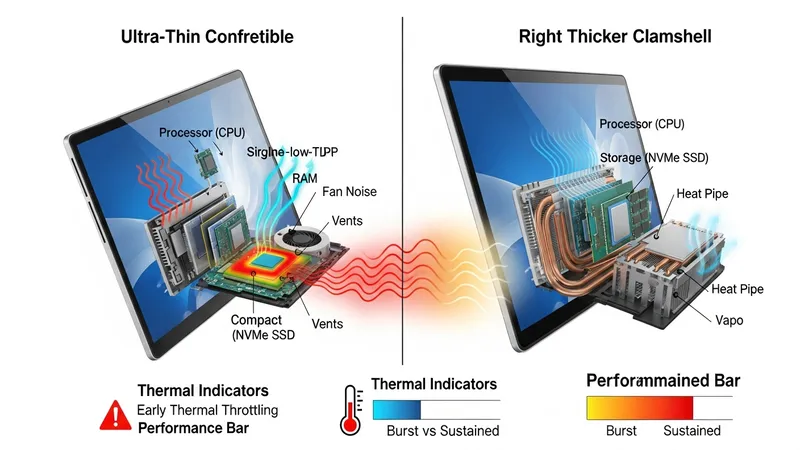
Thermal management is especially relevant in designs with integrated touch layers and thin profiles. Heat dissipation strategies such as heat pipes, vapor chambers, and strategically placed vents can influence how long a processor maintains its boost clocks. In some lightweight models, surface temperatures and fan noise may be constrained by the compact chassis, which can lead to early thermal throttling under prolonged load. Conversely, thicker convertibles or clamshells with more internal volume may sustain higher performance for longer intervals. Awareness of these design choices helps set expectations for tasks like video editing or extended simulations.
Graphics capability is another performance factor: integrated GPUs are sufficient for general productivity, web content, and video playback, while discrete GPUs appear in thicker or performance-focused 2-in-1s to support light gaming or accelerated creative workloads. Graphics workload also interacts with the touchscreen and display; higher-resolution panels increase pixel fill and can raise GPU load. Driver maturity for touch and stylus input can vary by vendor and affects responsiveness for drawing or handwriting applications. Storage throughput further influences perceived system fluidity during file transfers and complex project loads.
Benchmarks and workload-specific tests may provide comparative insight but should be interpreted alongside design intent. Real-world battery life and performance depend on workload type, thermal conditions, and background processes. For example, productivity tasks with intermittent CPU bursts and low GPU usage often run longer than sustained encoding or rendering tasks. Reviewing manufacturer specifications for TDP, memory configuration, and storage type can help anticipate likely behavior, and users may consult independent testing resources for workload-aligned comparisons rather than relying solely on peak numbers.