
Precision Aerospace Manufacturing: Key Processes In High-Tolerance Component Production

Manufacturing processes and machine tooling for high-tolerance component production
Machining strategies typically form the backbone of producing narrow-tolerance aerospace parts. Processes commonly used in Italy include 5-axis CNC milling for complex geometries, high-precision turning for shafts and bores, and fine grinding for critical surfaces. Suppliers of machine tools in Italy may offer thermal compensation, direct-drive spindles, and integrated probing that can reduce systematic errors. Process planners often characterise machine capability in terms of repeatability and process variation, and they may specify expected tolerance bands such as low-micrometre ranges depending on the feature and material.
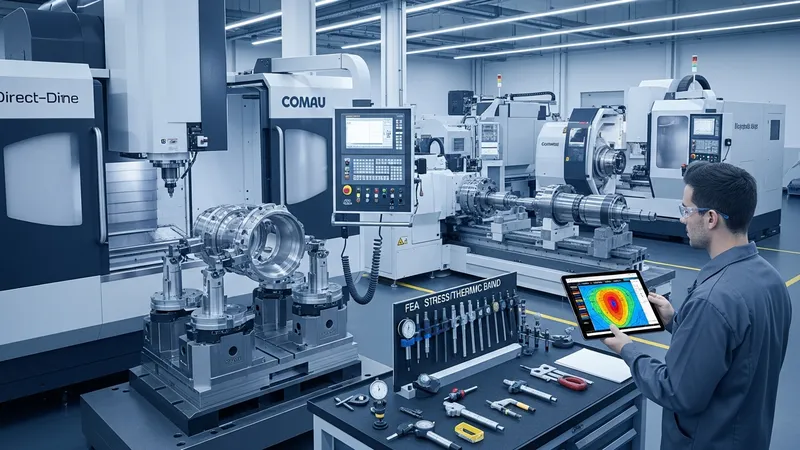
Fixturing and workholding design can strongly influence achievable accuracy. Proper fixture stiffness, minimised overhangs, and thermal isolation are typical considerations to avoid clamp-induced distortion. Italian automation integrators like Comau can provide bespoke cells that standardise part loading and reduce variation introduced by manual handling. Engineers in production planning may use finite-element analysis or empirical testing to assess how clamping forces and machining sequences will interact with material residual stresses.
Tooling and cutting strategy choices often account for material-specific behaviour. For titanium and nickel alloys, lower cutting speeds and careful toolpath planning may reduce workpiece heating and resultant dimensional drift. Carbide or cubic boron nitride tooling is frequently selected for wear resistance in abrasive alloys. Italian tooling distributors and machine-tool manufacturers typically provide data on recommended feeds, speeds, and tool life expectations that production teams may use to set conservative process windows for high-tolerance components.
Environmental and thermal controls can be necessary when tolerances approach the micrometre scale. Temperature stability in the workshop, closed-loop coolant temperature control, or climate-controlled enclosures around critical machines may be employed to limit thermal growth of parts and machines. In Italy, some precision workshops adopt such measures for specific product lines; these controls may be paired with regular machine warm-up procedures and documented measurement checkpoints to preserve consistency across production batches.