
Precision Aerospace Manufacturing: Key Processes In High-Tolerance Component Production

Metrology, inspection cycles, and traceability practices in Italy
Measurement systems used in Italian aerospace manufacturing commonly include bridge or gantry CMMs, optical scanners, and form-measurement machines. Calibration against national standards is typically performed by accredited bodies such as Accredia or by laboratories that trace results to the Istituto Nazionale di Ricerca Metrologica (INRIM). Metrology teams often define inspection plans that specify which features are measured, acceptable variation, and frequency of checks—ranging from 100% inspection of critical geometry to sampling plans informed by statistical process control.
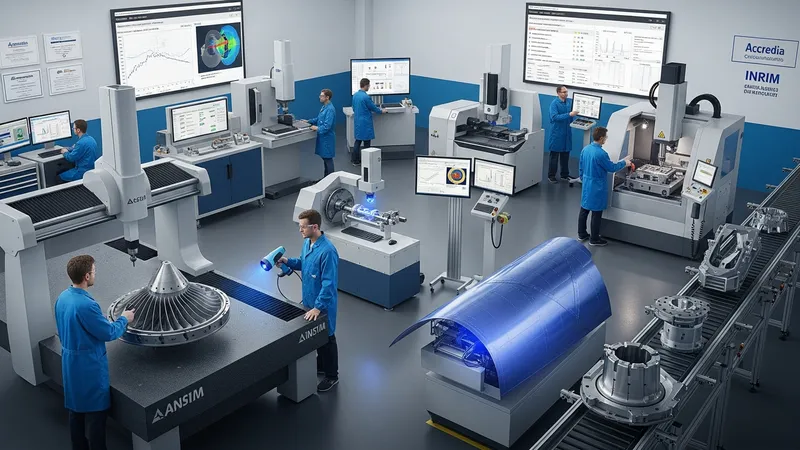
In-process measurement is commonly used to detect drift before large batches are completed. Probing cycles on CNC machines, optical comparators at process stations, and automated dimensional checks in assembly lines can reduce scrap and rework. Italian suppliers of metrology equipment, such as ZEISS Italia, may provide on-site support and software solutions that integrate measurement data into production control systems, enabling traceability from measured values back to specific machine settings or tool assemblies.
Documentation accompanying measurements is an important compliance element. Typical records include calibration certificates, measurement reports, and control charts that show feature stability over time. These records may be requested by prime contractors, certification authorities, or customers and are often organised to align with EN and UNI standards. In Italy, companies may also participate in inter-laboratory comparisons or proficiency schemes to maintain confidence in measurement capability and demonstrate adherence to accepted practices.
Selection of inspection methods is influenced by both feature geometry and production volume. For low-volume, highly critical components, exhaustive dimensional mapping and destructive validation tests may be appropriate. For higher-volume parts, a mix of automated checks and periodic full inspections can maintain throughput while controlling quality. Metrology teams in Italy typically balance inspection coverage with manufacturing flow, documenting rationales for chosen sampling frequencies in quality plans.