
Precision Aerospace Manufacturing: Key Processes In High-Tolerance Component Production

Manufacturing components for aircraft and spacecraft requires processes that control geometry, surface finish, and material properties to within narrow ranges. In Italy, firms and technology providers often focus on machining strategies, assembly protocols, and inspection systems that together reduce dimensional variation and ensure repeatable part performance. The activity typically spans initial material qualification, multi-axis cutting or forming, heat treatments, and a range of non-destructive and dimensional inspections that record conformance to technical drawings and applicable standards.
Precision in this context involves both machine capability and documented process control. Equipment selection, toolpaths, fixturing, coolant and cutting parameters, and environmental controls can all influence achievable tolerances. Italian industrial suppliers, metrology laboratories, and standards bodies commonly collaborate with manufacturers to validate processes and provide traceable measurement results. Production planning often integrates statistical process control and documented calibration regimes so measured parts can be traced to recognised Italian or European standards.
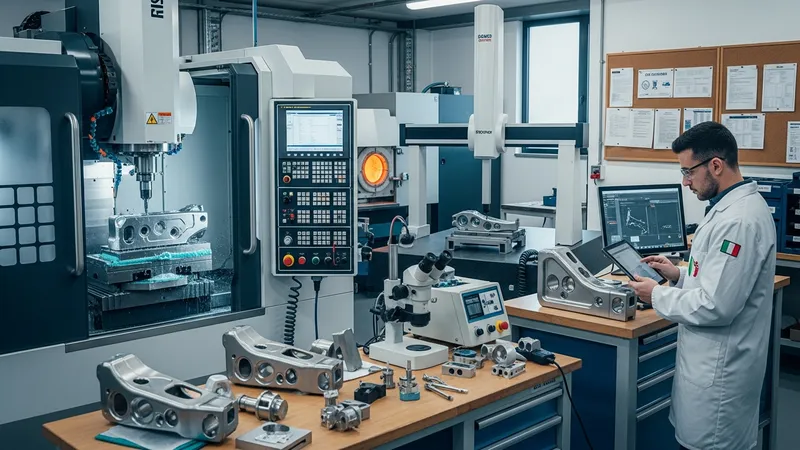
- Leonardo S.p.A. — Italian aerospace group involved in engine components and aerostructures; illustrates industrial-scale component production and assembly in Italy.
- Prima Power — Italian machine tool and laser/metalworking provider whose equipment is often used for high-precision forming and cutting in local supply chains.
- Comau — Italian automation and robotic systems supplier frequently used to standardise handling and machining operations that influence repeatability and tolerance control.
- ZEISS Italia — supplier of coordinate measuring machines and optical inspection systems used by Italian manufacturers to verify dimensional compliance.
Material selection is central to high-tolerance production. Aerospace alloys such as aluminium-lithium, titanium grades, and nickel-based superalloys have distinct machining responses and thermal sensitivities that may affect dimensional stability. In Italy, material certificates and supplier traceability commonly follow EN and UNI-adopted standards, and testing laboratories or accredited heat-treatment facilities provide associated documentation. Manufacturers typically plan machining sequences and stress-relief steps to reduce distortion and achieve target tolerances while maintaining certification records for each batch of material.
Machine-tool capability and process design often determine achievable tolerances. Multi-axis CNC centres, precision lathes, and controlled-environment grinding machines can reduce geometric error sources when combined with rigid fixturing and tool-path strategies. Italian machine tool suppliers and systems integrators may offer cells with temperature control, vibration isolation, or in-process probing to improve repeatability. Process planners can factor cycle time, tool wear rates, and in-process measurement to balance productivity with the repeatable accuracy required for aerospace parts.
Inspection and metrology are integrated throughout high-tolerance workflows rather than applied only at final inspection. Coordinate measuring machines (CMMs), optical scanners, and form testers are used for first-article inspection, in-process checks, and final verification. Calibration and traceability to national standards are often provided by accredited Italian bodies so measurement results carry recognised validity. Data from inspections may be fed back to machining parameters to support corrective actions and maintain statistical control over batches of components.
Non-destructive testing and materials testing complement dimensional verification in aerospace production. Techniques such as ultrasonic testing, eddy current, and dye-penetrant examination can detect subsurface or surface defects that dimensional checks will not reveal. Accredited Italian laboratories and in-house NDT teams often follow procedures aligned with EN standards and industry guidance; documentation from these tests typically accompanies part certification to provide a fuller conformity record for airworthiness or contractual review.
Process documentation and supplier control are crucial administrative elements that link physical processes to compliance. Work instructions, control plans, calibration records, and material certificates create a traceable chain from raw material to delivered component. Within the Italian context, many manufacturers reference UNI/EN standards and may engage with organisations such as Accredia for calibration accreditation. This administrative layer may often be as influential as machine capability in demonstrating that a produced part meets specified tolerances and quality requirements. The next sections examine practical components and considerations in more detail.