
High-Speed Internet Options: Key Factors To Consider When Choosing A Plan

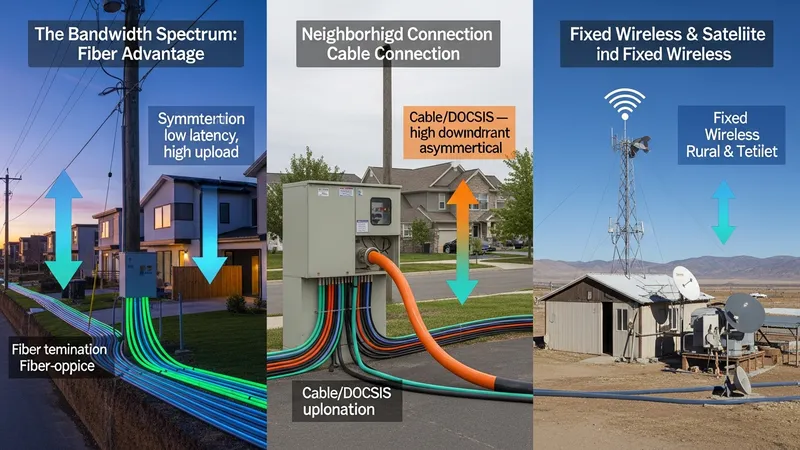
Connection types and how they relate to choosing a plan
Connection types form the foundational distinction among high-speed internet options and often dictate maximum achievable speeds and typical latency profiles. Fiber-optic infrastructure generally tends to offer higher symmetrical throughput and lower latency, which may suit users who upload large files or host services. Cable systems using DOCSIS standards may provide high downstream capacity but often with asymmetrical upload rates. Fixed wireless and satellite systems can extend coverage where wired lines are limited, though they may exhibit higher latency or throughput variability due to signal conditions. Each type’s engineering characteristics should be considered in relation to the household’s use cases rather than framed as universally superior.
Deployment patterns influence practical access to each connection type. Urban and suburban areas often have denser cable and fiber footprints, while remote regions may rely on wireless or satellite links. Deployment timelines for fiber expansion can be multi-year projects in some regions, so a local address may experience phased availability. Availability maps and independent coverage reports can be consulted to determine likely options at a specific location. When comparing options, factor in both current availability and any announced infrastructure upgrades that may alter future choices.
Performance under load is another consideration tied to connection type. Technologies that share spectrum or coaxial segments among nearby customers can experience reduced throughput during peak periods due to contention. Dedicated or less-shared architectures may maintain steadier performance. For latency-sensitive applications, the physical path length and the number of network hops matter; fiber links typically reduce propagation delays compared with satellite routes. These technical differences can be assessed as part of a measured comparison aligned with household activity patterns.
Equipment compatibility and interface standards vary by connection type and can affect home networking design. For example, fiber termination may require an optical network terminal, whereas cable services use a DOCSIS-compatible modem. Fixed wireless often requires externally mounted antennas and line-of-sight considerations. Evaluating the physical installation requirements and any in-home wiring implications helps set realistic expectations for setup complexity and potential additional costs over time.