
High-Speed Internet Options: Key Factors To Consider When Choosing A Plan

High-speed internet options encompass a range of network technologies and service plans that deliver broadband connectivity to homes and businesses. The concept involves both the physical connection method—such as fiber, cable, fixed wireless, or DSL—and the plan characteristics that affect everyday use: advertised download and upload speeds, latency, data allowances, service area coverage, and equipment requirements. Evaluating options requires understanding how these technical and contractual elements interact with typical household needs for streaming, remote work, gaming, cloud backups, and multiple concurrent users.
Key factors to consider when choosing a plan include raw throughput, network consistency, and how the provider manages traffic during busy hours. Throughput numbers often reflect peak or theoretical rates and may not match sustained speeds under load. Other elements such as latency, jitter, upload symmetry, and local infrastructure availability can influence real-world performance. Contract details, service tiers, and the presence of any data limits or extra fees are also relevant when comparing plans on a factual basis rather than on marketing claims.
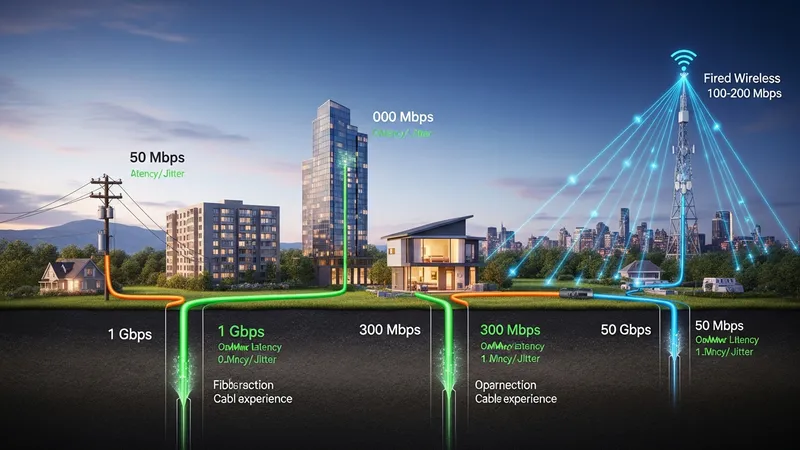
- Fiber-optic connections: Network technology that transmits data as light through glass fibers and often provides symmetrical upload and download capacity with low latency; availability can vary by region and deployment takes time to extend coverage.
- Cable (DOCSIS) connections: Uses hybrid fiber-coaxial infrastructure commonly deployed in urban and suburban areas; downstream speeds can be high while upload speeds are typically lower than fiber, and actual throughput may vary with neighborhood usage patterns.
- Fixed wireless and cellular-based broadband: Delivers internet over radio links to an outdoor or rooftop antenna or via mobile networks; these options can provide rapid deployment where wired infrastructure is limited but may be subject to signal variability and data policies.
Comparing technologies often begins with assessing typical speed ranges and how those speeds match household activities. For example, multiple high-definition video streams and large uploads for cloud backups often benefit from higher sustained download and upload rates. Latency-sensitive tasks such as interactive gaming or real-time collaboration may require lower latency and stable jitter metrics. The relationship between advertised maximums and measured throughput can depend on shared network segments, so measured speeds during peak usage hours may be lower than off-peak measurements.
Coverage and availability usually shape which options are practical for a given address. Urban areas may have access to multiple technologies, while rural addresses can have fewer wired options and may rely more on fixed wireless or satellite services. Infrastructure deployment typically follows investment and population density patterns, so availability can change over time as networks are upgraded. When evaluating coverage, it may be useful to consider both current service maps and reported timelines for planned network expansions in the local area.
Data allowances and fair-use policies can influence plan suitability for households with high consumption patterns. Some plans may include monthly data caps or implement traffic management after thresholds; others offer unlimited data but may still moderate speeds during congestion. Understanding how a provider measures and enforces data usage can be relevant for those who stream high-resolution video, perform frequent large uploads, or operate multiple connected devices. Billing terms for excess usage are a contractual detail to review as part of a neutral comparison.
Equipment and service-level considerations are part of the selection process as well. Providers may supply modems, gateways, or customer-premises equipment with different features such as integrated Wi-Fi, voice ports, or support for mesh extenders. Equipment rental fees and ownership options can affect long-term costs, while the quality of a local Wi-Fi setup can influence perceived internet performance within the home. Warranty, maintenance, and typical service response times may vary among providers and are relevant factual considerations rather than qualitative endorsements.
In summary, high-speed internet options involve a mix of technologies, performance metrics, coverage realities, and contract details that together determine plan suitability for specific needs. Evaluating these elements in parallel—speeds, latency, data policies, availability, and equipment—can help clarify which plans may match a household’s usage profile. The next sections examine practical components and considerations in more detail.