
Digital Twin Platforms: Foundations And Applications In Manufacturing

Modeling, simulation, and analytics methods used in manufacturing twins
Model selection depends on the use case and available data. Physics-based models can capture mechanical and thermodynamic behavior for equipment-level simulation, while data-driven models, including time-series forecasting and supervised learning, may detect operational anomalies or predict failures. Hybrid approaches combine first-principles constraints with statistical learning to improve generalization when data are limited. In U.S. manufacturing environments, teams often pilot simpler models for baseline monitoring and progressively introduce more sophisticated simulations as data quality improves.
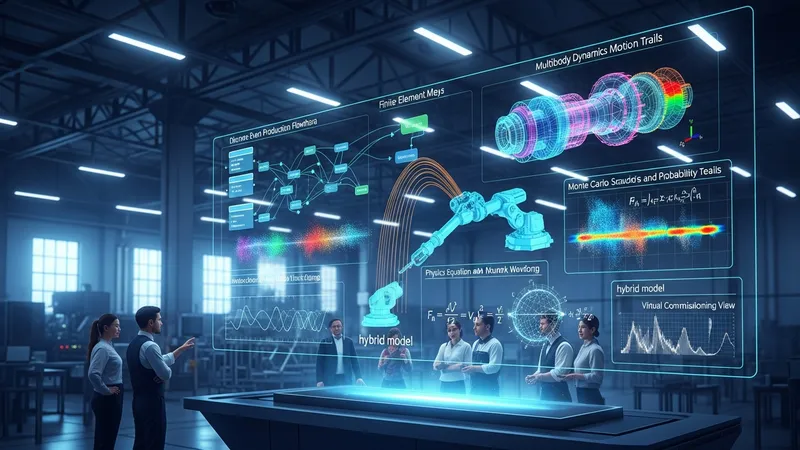
Simulation capabilities within platforms may include discrete-event models for production flows, finite-element or multibody dynamics for equipment behavior, and Monte Carlo approaches for variability analysis. Virtual commissioning uses these simulations to validate control logic and layout changes prior to physical deployment, which can reduce unplanned downtime during changeovers. Simulation fidelity is typically balanced against computational cost and the time required to run experiments, especially when cloud compute is billed per use.
Analytical workflows often combine descriptive dashboards with automated alerts and root-cause analysis pipelines. Time-series anomaly detection can flag deviations from expected operating envelopes, and causal analysis tools may help link anomalies to upstream events. For U.S. manufacturers, integration of analytics outputs with maintenance management systems can streamline work order generation and provide operational context for technicians, while preserving audit trails required by internal controls.
Model governance and validation practices help maintain trust in twin outputs. Validation often compares model predictions to historical events and has scheduled recalibration routines as processes or equipment age. Documentation of model assumptions, input data ranges, and retraining triggers is commonly used to support cross-functional reviews. Engineering and operations teams typically agree on acceptance criteria before models influence automated actions on the plant floor.