
Digital Twin Platforms: Foundations And Applications In Manufacturing

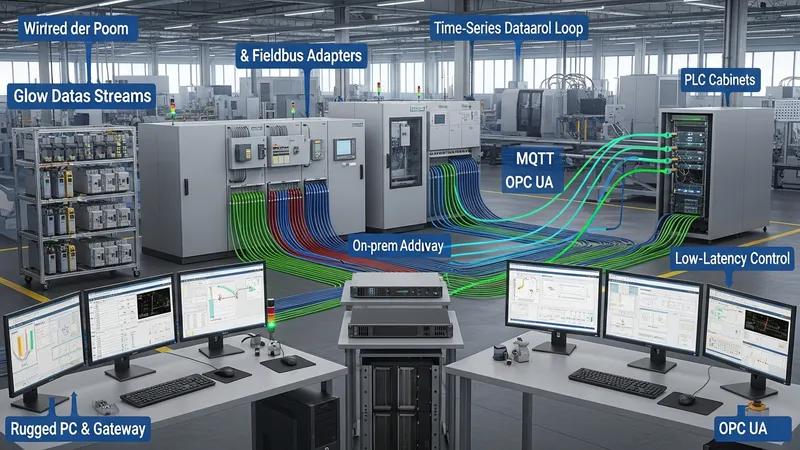
Platform architectures and data integration relevant to manufacturing
Architectural patterns for manufacturing-focused digital twin platforms commonly separate edge, cloud, and application layers. Edge components run on-premises gateways or industrial PCs to collect high-frequency telemetry and execute low-latency control loops, while cloud services host scalable storage, simulation engines, and cross-site analytics. Data integration commonly uses time-series databases, message brokers (for example MQTT), and API gateways to move information between layers. U.S. manufacturers often evaluate architectures for compliance with corporate IT policies and sector regulations, and may use hybrid patterns to limit sensitive data leaving plant networks.
Interoperability is a frequent practical challenge. Device-level protocols such as OPC UA and legacy fieldbus adapters are often required to connect diverse machine assets. Mapping and harmonizing semantic models can reduce downstream engineering effort; some teams apply standard information models or employ middleware that translates vendor-specific telemetry into normalized schemas. In the U.S. context, adherence to automation standards and the ability to interface with ERP and MES systems are common procurement considerations.
Latency and bandwidth considerations shape whether analytics run locally or in a centralized cloud. Time-critical anomaly detection and control-loop support often run at the edge, while historical trend analysis and fleet-level comparisons typically occur in cloud environments. This division can affect platform selection and the design of data retention policies. Manufacturers designing pilots typically measure network performance and instrument sampling needs before scaling.
Data governance and lifecycle practices are important architecture inputs. Defining which data remain on-premises, which are aggregated in the cloud, and how long telemetry is retained influences storage cost and compliance posture. Technical teams in the United States may coordinate with legal or security groups to address intellectual property concerns and meet sector-specific reporting requirements. Such governance decisions also affect which integration patterns and third-party services are acceptable.