
Container Houses: Design Trends And Construction Methods For 2026

Insulation approaches and moisture control for container housing
Thermal performance in steel shell structures can be challenging because the metal conducts heat and cold rapidly, producing thermal bridging where the shell intersects interior finishes. Insulation approaches commonly used include closed-cell spray foam applied directly to the interior shell, mineral wool in furring channels with an air gap, and insulated panel overlays that add continuous insulation on the exterior. Each method may influence condensation behavior differently; assemblies that allow drying in at least one direction often reduce long-term moisture risk compared to fully vapor-impermeable systems.
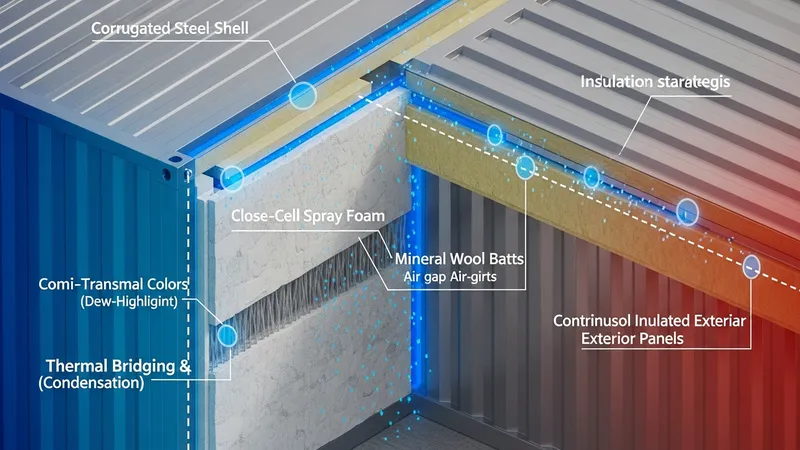
Condensation control strategies typically combine thermal design with controlled ventilation. Continuous insulation or thermal breaks at junctions reduce cold spots that attract moisture, while mechanical ventilation with heat recovery may manage humidity in tight volumes. Designers sometimes use hygrothermal analysis to predict dew-point locations within wall assemblies, particularly in climates with large seasonal humidity swings. Where interior finishes are placed directly over insulation, service routing and inspection access should be considered to avoid concealed moisture accumulation.
Fire safety and acoustic requirements also influence insulation selection. Mineral wool can provide both thermal and acoustic attenuation and is non-combustible, while spray foam can add structural rigidity and air sealing but may require additional measures for fire separation and off-gassing control. Acoustic partitions between units may be added via double stud walls or resilient channels to mitigate low-frequency transmission through metal shells. Compliance with local building codes regarding insulation materials and fire barriers remains a common driver of product choice and detailing.
Installation quality matters for long-term performance. Ensuring continuous coverage without gaps, controlling compression of batt materials, and sealing interfaces around penetrations reduce thermal bypass and moisture entry. Prefabricated insulated panels or cavity insulation installed in a factory setting may achieve more consistent results than entirely field-applied systems, although transport dimensions and site access can limit panel sizes. Designers often document expected performance ranges rather than absolute values, noting that actual outcomes depend on workmanship and climatic exposure.