
Carbon Accounting Software: How Enterprises Track Emissions And Environmental Impact

Carbon Accounting Software: Data Sources and Integration
Data sourcing is a fundamental component of enterprise emissions accounting. In the United States, common inputs include utility meter data, fuel purchase records, facility energy management systems, and fleet telematics. Software solutions may ingest these inputs via APIs, batch file uploads, or integrations with ERP and building management platforms. Integration design often determines how frequently inventories can be updated: near-real-time feeds for electricity meters can support monthly or daily tracking, while procurement systems may supply periodic purchase records that require mapping to emission factors.
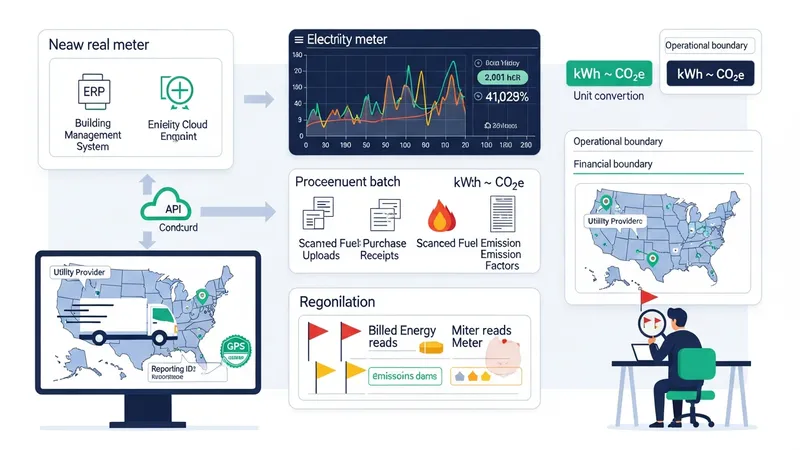
Mapping data to organizational boundaries and operational control models is an early integration task. Enterprises may choose control approaches aligned with established guidance from the EPA or the Greenhouse Gas Protocol; software often provides templates for operational and financial boundaries. Data reconciliation routines commonly flag inconsistencies between billed energy and meter reads, enabling analysts to investigate discrepancies. For multisite US companies, handling different utility providers, state-level reporting identifiers, and varying unit measures are typical integration considerations.
Supplier and scope 3 data collection is frequently more complex than facility-level inputs. United States organizations that track upstream emissions may rely on supplier questionnaires, lifecycle databases, or industry-standard emission factors; software may include modules to manage supplier responses or to import databases of emission factors relevant to US fuel mixes and manufacturing processes. Privacy and data-sharing constraints can affect the level of detail suppliers provide, so systems often accept aggregated inputs or proxy values with clear traceability.
Data governance and security are practical priorities when integrating across enterprise systems. Many US enterprises require role-based access, encryption in transit and at rest, and retention policies that align with corporate records management. Audit trails that capture who modified data, when, and why can support assurance activities. When planning integrations, organizations often document data lineage, expected update frequencies, and fallback procedures for when automated feeds fail.