
AI Medical Coding Platforms: Understanding How Automation Supports Clinical Documentation

Types of automated coding approaches and models relevant to clinical documentation
Automated coding approaches in U.S. clinical environments commonly fall into several categories: rule-based encoders that apply deterministic mapping and payer edit logic; machine learning models that learn associations between text and codes from labeled examples; and hybrid systems that combine rule-based checks with statistical or neural NLP components. Rule-based systems may be predictable for certain mappings and payer rules, while machine learning methods may handle linguistic variability better but often require labeled data and careful validation. Hybrid models are frequently used to balance repeatable rule application with flexible language understanding in United States settings.
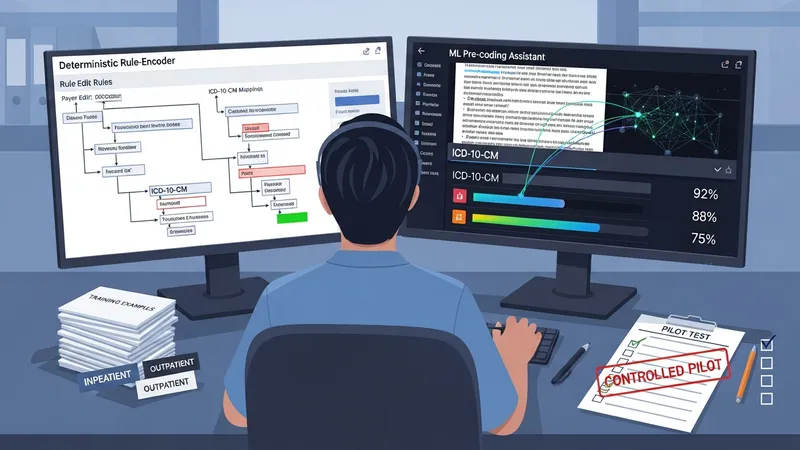
Implementation choices often reflect workflow needs: encoder-style tools can be integrated as reference engines within coder workflows, while ML-driven systems may operate as pre-coding assistants that flag likely codes for human review. For inpatient versus outpatient contexts, model training data and rulesets typically differ because ICD-10-CM sequencing, principal diagnosis determination, and procedure coding conventions may vary. Organizations commonly pilot different approaches in controlled areas before broader rollout to evaluate fit with specialty documentation and claims processes.
Model validation and monitoring are practical considerations: in the United States, acceptable performance is often assessed against coder-reviewed gold standards and through ongoing sampling for accuracy and compliance with CMS and payer expectations. Version control for mapping logic and annotation guidelines helps maintain traceability. Additionally, transparency about how a system arrives at a suggestion—such as showing the source sentence and extracted entities—can aid coder acceptance and efficient review within U.S. clinical coding teams.
Operational integration considerations include where in the documentation lifecycle the tool acts (real-time during documentation, post-encounter pre-billing, or retrospective coding audits) and how coders interact with suggested codes. Each mode has trade-offs: real-time suggestions may support documentation completeness but require in-EHR integration, while post-encounter tools may focus on billing accuracy and require strong interfaces with practice management and claims systems in U.S. healthcare organizations. These distinctions help frame pilot design and evaluation.