
AI Medical Coding Platforms: Understanding How Automation Supports Clinical Documentation

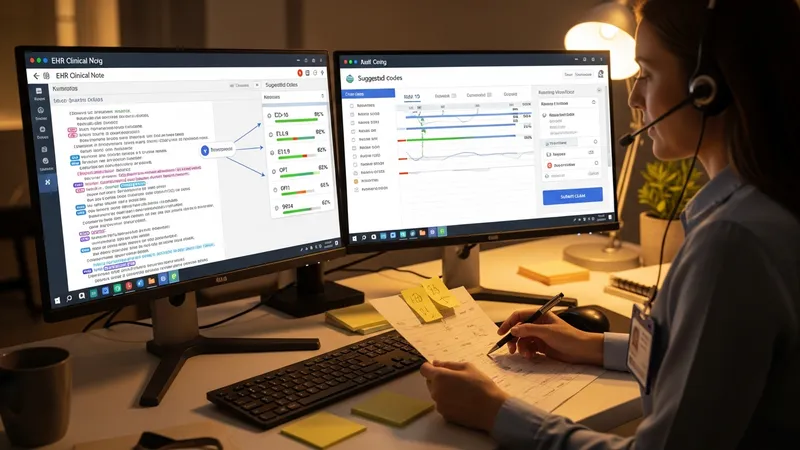
Automated platforms that assist with assigning standardized clinical codes use software to analyze clinical notes, procedure records, and encounter data and suggest appropriate diagnostic and procedure codes. These systems often apply natural language processing (NLP) to extract clinical terms from narrative text, map extracted concepts to code sets such as ICD-10-CM and Current Procedural Terminology (CPT), and present suggested codes for review. In United States clinical settings, the software typically integrates with electronic health records (EHRs) and billing workflows so coding suggestions can align with claims preparation and internal documentation improvement efforts.
Such platforms vary by method and scope: some focus on automated suggestions for common diagnoses, others aim to support inpatient coding, and some include tools for clinical documentation improvement (CDI). Outputs may include suggested codes, confidence scores, links to source text, and audit logs for reviewer actions. Human coders or clinical documentation specialists commonly review and validate suggested codes before submission to payers. The extent of automation and the human review workflow may differ by product and facility size, and each approach may affect coder workload, audit readiness, and claim accuracy in different ways.
- 3M Health Information Systems — coding and documentation tools: offers software that supports coder workflows and mapping to ICD-10-CM for inpatient and outpatient settings, with hospital-focused implementations in the United States.
- Optum360 EncoderPro+ — coding reference and encoder tools: provides an encoder and coding reference environment used by U.S. coding professionals to apply CPT and ICD-10-CM guidance within billing and documentation workflows.
- Nuance Clinical Documentation solutions — documentation and coding assistance: includes speech recognition and documentation tools that may integrate with coding processes and clinical documentation improvement in U.S. health systems.
Selection criteria for examples above reflect commonly referenced vendors and tools in U.S. healthcare coding discussions and focus on systems that interact with standard U.S. code sets and payer processes. These items were chosen to illustrate different approaches—vendor-provided encoder/reference tools, enterprise coding suites, and documentation-centered solutions—rather than to rank them. Readers should consider compatibility with institutional EHRs, support for ICD-10-CM and CPT, and capacity for human review when comparing systems in United States contexts.
In practice, automated coding systems often rely on NLP pipelines that identify clinical entities, normalize terminology, and map to code concepts. The mapping step may consult code set rules, payer edits, and facility-specific guidelines. NLP performance can vary with documentation style, specialty-specific language, and the quality of structured data inputs. In United States settings, systems that explicitly reference ICD-10-CM and CPT nomenclature and that can surface the originating text segment for reviewer verification may support clearer coder decision-making and defensible audit trails.
Human oversight remains a central element: many organizations use “human-in-the-loop” workflows where suggested codes are reviewed by certified coders or CDI specialists before claim submission. This arrangement can help identify ambiguous documentation, clinical nuances, or coding rules that automated mapping may not reliably capture. Reviewers typically examine confidence indicators, source text highlights, and related clinical fields. The review step also provides feedback loops that may be used to tune system configuration or inform vendor-supported model updates within U.S. compliance frameworks.
Data privacy and regulatory alignment are important considerations in United States deployments. Systems that process protected health information (PHI) must adhere to HIPAA safeguards and institutional policies for data handling. Contracts, Business Associate Agreements, and technical safeguards such as encryption and access controls typically form part of a compliance posture. Additionally, alignment with Centers for Medicare & Medicaid Services (CMS) documentation expectations and audit readiness procedures is often a planning focus when introducing automation into U.S. coding operations.
Operationally, organizations may evaluate automated coding by tracking coder productivity metrics, query volumes for documentation clarification, and claim denial patterns over time. Such measurements may indicate where automation can supplement routine tasks and where manual review continues to be necessary. These evaluations typically use conservative interpretation—automation may influence metrics in measurable ways, but results can vary by specialty mix, documentation practices, and implementation scope. The next sections examine practical components and considerations in more detail.