
AI In Manufacturing: Understanding Applications And Industry Use Cases

AI in Manufacturing: Production Planning, Scheduling, and Supply Chain Analytics
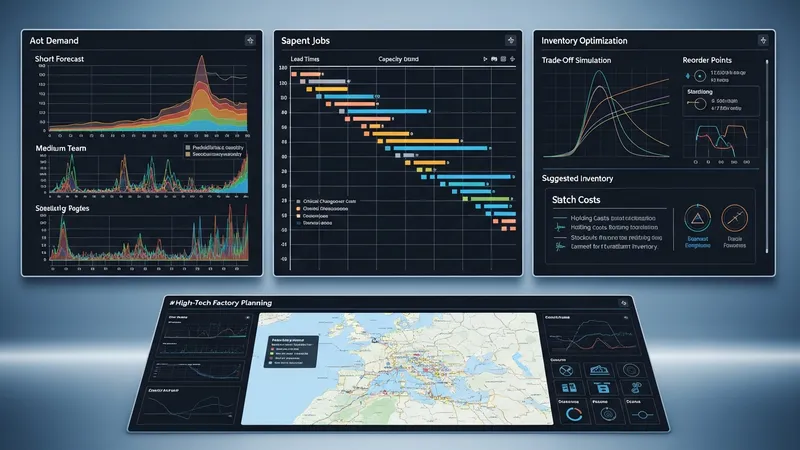
Forecasting models often combine historical demand data, seasonality, and external indicators to generate short- and medium-term demand signals that feed production planning. Machine learning methods such as gradient-boosted trees and recurrent architectures can model complex patterns, while probabilistic forecasts provide measures of uncertainty used in planning buffers. Planners commonly integrate AI outputs into constraint-based scheduling algorithms that consider capacity, lead times, and changeover costs to produce feasible schedules. These systems may be run as scenario analyses so planners can compare outcomes under different demand or supply assumptions.
Inventory optimization uses demand forecasts and lead-time variability to suggest reorder points and batch sizes; stochastic optimization or simulation can quantify trade-offs between holding costs and stockout risks. Supply-chain analytics can also use anomaly detection to flag supplier delays or transportation disruptions based on transactional and telemetry data. Effective implementation typically requires clean master data for part definitions, lead times, and routing information, and attention to alignment between model assumptions and real-world constraints like minimum order quantities or shelf life.
Human oversight remains important: planners often review algorithmic schedules to incorporate tacit knowledge about customer priorities, maintenance windows, or market events not captured in available data. Transparency in model outputs—such as explainable features or scenario visualizations—can help build trust and support adoption. Combining AI-driven recommendations with collaborative planning meetings and what-if analyses may yield more resilient operational plans that blend statistical signals with domain expertise.
Practical considerations include computing and integration choices: some organizations run forecasts in cloud-based analytics platforms, while others prefer on-premises solutions to keep data within factory networks. Insider guidance suggests validating models across multiple product families and time horizons, and maintaining simple fallback rules in case of data outages. Tracking forecast accuracy over time and linking improvements to operational KPIs such as cycle time, fill rate, or inventory turns helps quantify the contribution of analytic tools.