
AI In Manufacturing: Understanding Applications And Industry Use Cases

AI in Manufacturing: Robotics, Human–Machine Collaboration, and Governance
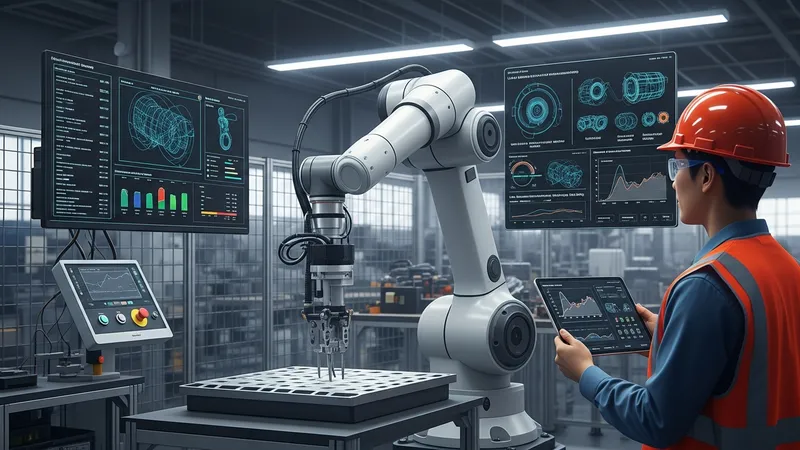
Robotics applications that incorporate AI range from flexible pick-and-place using vision-guided grasping to adaptive control for force-sensitive assembly. Learning-based methods such as imitation learning or reinforcement learning may be used for complex manipulation tasks, although these techniques often require simulation and domain randomization to reduce training time on physical hardware. Collaborative robots with force sensing and safety-rated speed limits can work alongside operators for tasks that benefit from human judgement. Integration requires assessing the task cycle, safety zones, and tolerance for variation to determine appropriate robot classes and control architectures.
Data governance and model lifecycle management are essential for reliable operation: teams commonly implement versioning for models, datasets, and inference code, together with monitoring that tracks input distributions and performance metrics. Explainability and traceability help when investigating incidents or unexpected behavior. Governance frameworks often define roles for data stewards, ML engineers, and operations leads to ensure clear ownership of model updates, testing, and rollback procedures. Compliance with industry safety standards and internal audit requirements frequently shapes deployment timelines and documentation needs.
Human factors are important: introducing AI-enabled automation can change operator tasks, shifting focus from manual execution to exception handling and system supervision. Training programs that present system limitations and expected failure modes may support smoother adoption. Insider considerations include designing operator interfaces that provide clear state information and recommended actions, and staging automation in ways that preserve operator agency and safety. Continuous feedback loops that capture operator corrections can also supply labeled examples for future model improvement.
Maintenance of deployed AI systems typically blends software and mechanical maintenance practices. Scheduled model retraining, calibration of sensors, and verification of perception pipelines are common tasks. Teams often prepare runbooks that describe how to validate system health, interpret alerts, and execute fallback procedures when models degrade. These practices, combined with incremental rollouts and careful metric tracking, may support sustainable adoption while reducing operational surprises.