
Virtual Fitting Rooms: How Digital Try-On Technology Works For Online Shoppers

AI-Driven Body Measurement and Size Estimation
AI-driven measurement approaches typically fall into categories such as single-image estimation, multi-image reconstruction, or depth-assisted scanning. Single-image methods use statistical relationships learned from labeled datasets to infer body dimensions from a single front or side photo. Multi-image methods combine several views to triangulate measurements. Depth-assisted scanning uses additional sensor input when available to refine estimates. Each method may provide useful approximations for size selection but can vary in precision depending on input quality and model training data diversity.
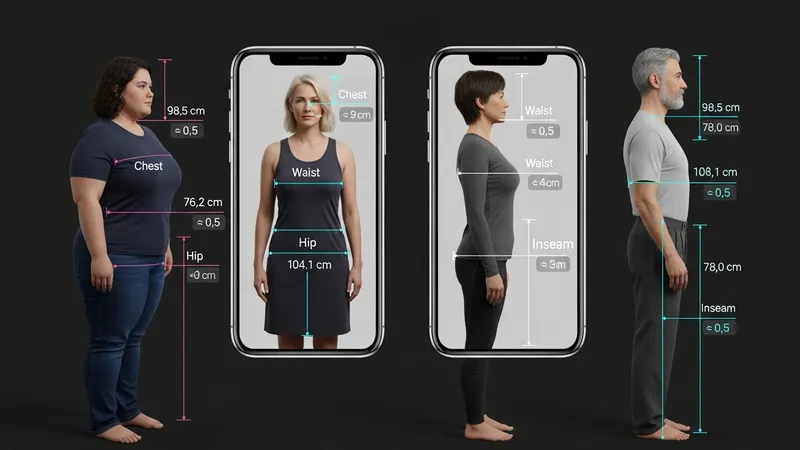
Model training and dataset composition influence estimation performance. Models trained on diverse body shapes, poses, clothing types, and skin tones may generalize more reliably across users, while limited datasets can introduce biases or systematic errors. That is why practitioners often validate models on separate datasets and report expected ranges of uncertainty rather than single-point measures. Communicating uncertainty to users — for instance by indicating a likely size range — can help set expectations and reduce overconfidence in automated estimates.
Privacy and consent are important when collecting measurement-related images. Some systems minimize retained data by performing measurement on-device and only transmitting derived metrics, or by anonymizing and aggregating data for analytics. Legal frameworks in different regions may classify biometric measurement information as sensitive, so design teams often treat measurement workflows conservatively: they implement minimal data retention, clear opt-in flows, and straightforward explanations of how results are used within the shopping process.
Practical considerations for deployment include calibration, user guidance, and integration with product sizing charts. Calibration steps may ask users to stand at a certain distance or to include a reference object, although developers increasingly prefer solutions that avoid additional props. Mapping measured dimensions to vendor size charts typically requires normalization and sometimes manual validation for particular brands or cuts. Teams often pilot size-mapping models on a subset of SKUs to refine mappings before wider application.