
Professional Network Advertising Platforms: Understanding Targeting And Audience Segmentation

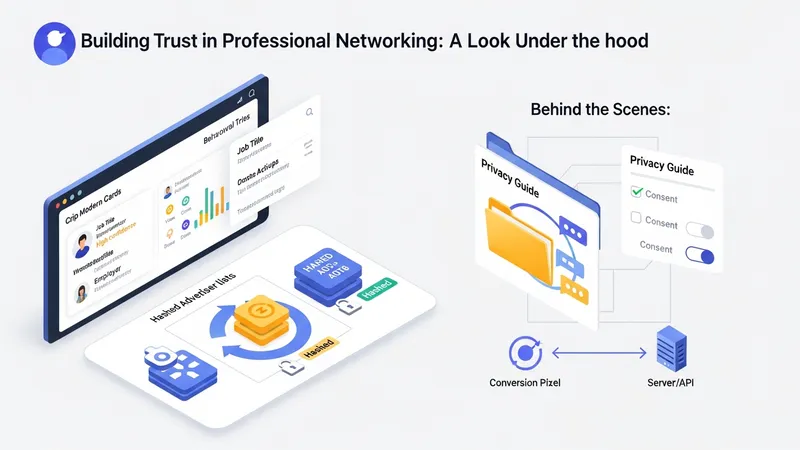
Data sources, privacy practices, and platform integrations
Professional network platforms typically use three primary data types for segmentation: first-party profile data, first-party behavioral data, and sometimes third-party or vendor-supplied enrichments. Profile fields (job title, employer) are usually self-reported and therefore considered higher-confidence. Interaction signals (content views, clicks, group activity) are logged by the platform and can indicate current interests. Some platforms also accept hashed lists from advertisers for custom audience matching. These different sources may be combined through platform tools or via external data management systems to construct composite segments.
Privacy and compliance considerations influence how audience data may be used. Many platforms provide documentation on permissible targeting attributes and on how seeded advertiser lists should be prepared (hashing, minimum list sizes). Where regulations require consent or restriction of certain attributes, platforms often adapt by limiting access to sensitive fields. Integrations such as conversion tracking pixels or server-side APIs enable measurement while introducing considerations about cross-site tracking and data retention; practitioners commonly review platform privacy guides and internal data governance policies before enabling these integrations.
Matching workflows for seeded audiences usually employ hashing and secure uploads to protect raw contact data. After matching, platforms often report only aggregate metrics or matched-size estimates to avoid exposing identifiable data. When using third-party enrichments, teams may verify vendor provenance and the freshness of attributes, since stale data can degrade segmentation accuracy. It is common to schedule periodic audience refreshes and to document data lineage so that attribution and compliance audits can reconcile observed outcomes with the inputs used to define audiences.
Technical integrations can affect the granularity of segmentation and reporting. Server-to-server conversion events typically provide more reliable attribution than client-side pixels in cases where ad blockers or privacy settings interfere with tracking. Platform APIs may also support automation of audience creation and campaign updates, which can be useful for large-scale segmentation strategies. However, automation requires careful error handling and naming conventions to avoid accidental audience overlap or incorrect exclusions.