
Professional Network Advertising Platforms: Understanding Targeting And Audience Segmentation

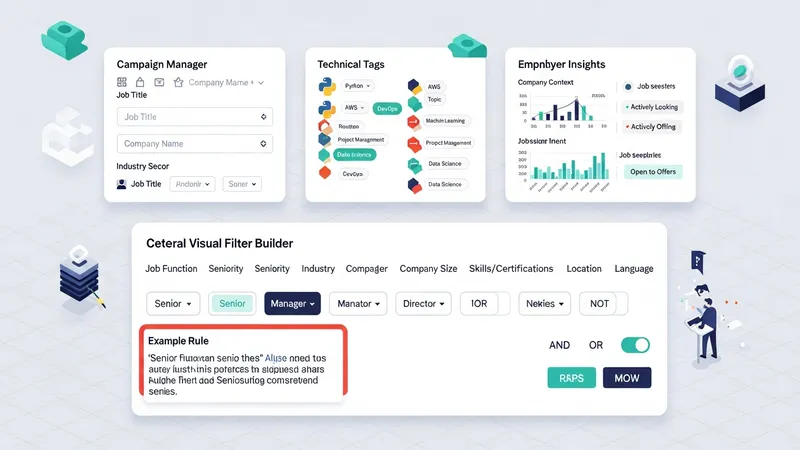
Targeting dimensions used by professional network advertising platforms
Professional-focused platforms usually expose a set of targeting dimensions that reflect occupational attributes. Common categories include job function, seniority level, industry classification, company size, and specific skills or certifications. These dimensions can often be combined with demographic filters such as location or language. When using examples from the list on Page 1, LinkedIn Campaign Manager tends to emphasize job and company metadata, Stack Overflow places weight on technical topics and tags, and Glassdoor may combine employer-related context with job-seeker intent. Practitioners typically select dimensions that most closely match campaign objectives while monitoring audience scale.
Many platforms allow Boolean combinations to refine segments—for instance, targeting senior product managers at mid-sized companies but excluding recruiters. Such combinations can improve relevance but may reduce available impression volume, so teams often iterate between broader and narrower sets. Seed-list workflows are common: an advertiser uploads a list of known contacts to create a matched audience and then uses lookalike or expansion tools to reach similar profiles. These mechanisms generally rely on hashed identifiers and platform matching to preserve basic privacy protections.
Contextual and interest signals may supplement explicit profile filters. On Stack Overflow, for example, topic tags and question categories can act as proxies for technical interests; on LinkedIn, group memberships and content interactions can suggest active professional priorities. These behavioral layers are often treated as probabilistic indicators, and some platforms expose confidence scores or audience sizing estimates to guide decisions. Using a mix of deterministic and behavioral attributes can help capture both stable role-based segments and more dynamic interest-based audiences.
Operational considerations include maintaining clear naming conventions for segments, tracking overlap between audiences, and documenting the origins of seed lists. Platforms usually report estimated audience size before launch, which can be useful for planning but may change as exclusions or additional filters are added. Teams often build experiment plans that compare a conservative deterministic audience against a broader behavioral expansion to observe performance trade-offs. Readers may find it useful to record segment definitions alongside creative variants to support later analysis.