
Plumbing And Emergency Repairs: How Professional Plumbers Address Urgent Water And Drain Issues

Plumbing emergency repair refers to the structured process used by trained technicians to assess and address immediate failures in water supply and drainage systems. Professionals typically begin with rapid containment to limit water ingress and related hazards, then proceed to diagnostic steps that identify the source and scope of a fault. Work at this stage often balances temporary measures—such as isolating a valve or applying a clamp—with assessment tasks like visual inspection, moisture mapping, and basic pressure testing to determine if a localized repair or broader intervention is needed.
Following initial containment, technicians usually prioritize actions that reduce safety and property risk while collecting data for a repair plan. Common priorities include ensuring electrical areas are safe, documenting damage for records, and identifying affected fixtures, pipe runs, or drainage channels. Skilled practitioners may coordinate with other trades or building managers where structural concerns or multi-system impacts are present. The overall goal in early stages is to stabilize the situation and produce a clear diagnostic picture that informs appropriate repair techniques and timelines.
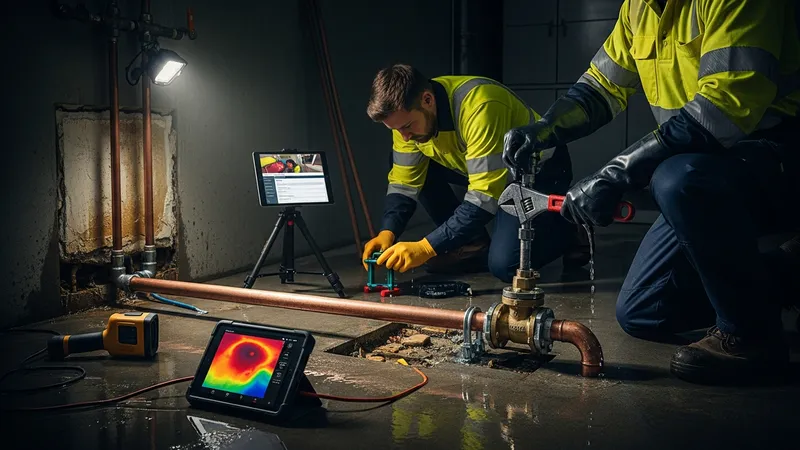
- Leak detection methods — acoustic listening devices, infrared thermography, and moisture meters used to locate hidden pipe failures and distinguish active leaks from residual moisture.
- Blockage removal techniques — mechanical augers, hydro-jetting, and camera-guided clearing that are applied depending on blockage type, pipe size, and access constraints.
- System inspection approaches — CCTV drain surveys, pressure testing, and visual checklist inspections that map system condition and identify corrosion, joint failure, or misalignment.
Acoustic and thermal leak detection tools often form the first detailed diagnostic step after a visible failure is stabilized. Acoustic devices may detect the sound of running water in concealed cavities, while infrared imaging can reveal temperature differentials where hot or cold lines have breached or where moisture affects surrounding materials. Moisture meters and probes can quantify dampness levels to help distinguish active leaks from historical water intrusion. Together, these methods often reduce unnecessary invasive openings by focusing interventions where evidence indicates active flow or saturation.
Blockage removal methods are selected based on the likely cause and location of an obstruction. Mechanical augers or drain snakes can clear hair, small debris, or collapsed scale from accessible runs. Hydro-jetting, which uses pressurized water, may be employed where scale, grease, or mineral buildup is extensive and pipe material and condition permit such force. CCTV cameras are frequently used in tandem with clearing techniques to confirm the nature of the blockage and verify that clearing operations have restored through-flow without damaging pipe walls.
System inspection approaches help create a broader picture of network condition beyond the immediate failure. CCTV drain surveys may reveal root intrusion, joint failures, or long-term corrosion that suggests sections of piping require replacement rather than spot repair. Pressure testing, sometimes performed at controlled intervals, can indicate whether a closed system holds under expected loads or whether hidden leaks are present. Inspection findings often influence whether a temporary repair is appropriate or whether a staged replacement plan is more suitable for long-term reliability.
Repair selection typically weighs material compatibility, expected remaining service life, and accessibility. Temporary measures might include external clamps, epoxy wraps, or valve isolation to manage flow while parts are sourced. Permanent repairs can range from sectional pipe replacement using matched materials to trenchless relining techniques that restore pipe integrity with minimal excavation. Decisions about repair methods are informed by inspection data, structural constraints, and safety considerations, and they often consider how a repair will affect overall system hydraulics and future maintenance access.
In summary, responding to urgent water and drainage failures involves a sequence of containment, targeted diagnostics, and context-sensitive repair planning. The examples listed above illustrate typical tools and methods used to locate leaks, clear blockages, and inspect systems to guide repair work. Subsequent sections examine practical components and considerations in more detail.