
On-Premise Accounting Software: Key Features And Core Capabilities Explained

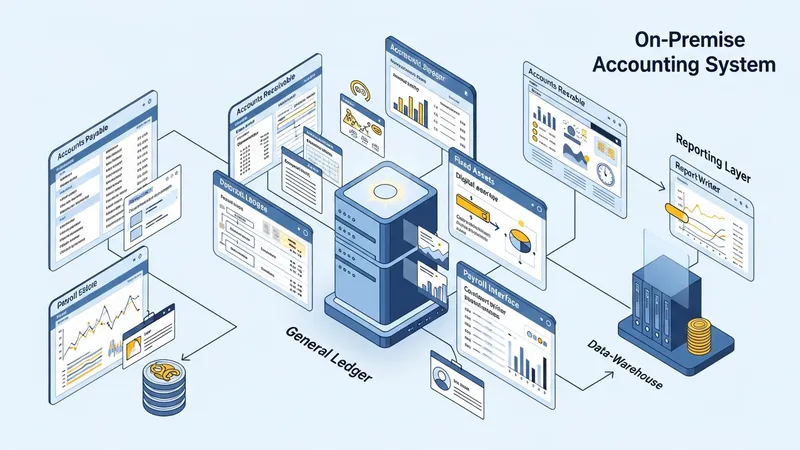
Core functional modules in on-premise accounting software
Core functional modules typically found in on-premise accounting solutions include the general ledger, accounts payable, accounts receivable, fixed assets, and payroll interfaces. The general ledger serves as the central repository for journal entries, period closings, and consolidated financial statements. Accounts payable modules often support vendor management, invoice matching, and payment scheduling. Accounts receivable modules typically handle invoicing, cash application, and aging analysis. Fixed-asset modules usually include depreciation schedules, asset tracking, and disposal processes. Payroll interfaces commonly exchange data with HR systems to ensure consistency between personnel records and payroll runs.
Reporting modules may provide built-in financial statements and configurable report writers for custom extracts. Many on-premise systems include a reporting or business intelligence layer that pulls from the transactional database and allows creation of parameterized reports and scheduled output. Organizations may standardize report templates to meet internal and statutory requirements. Where advanced analytics are required, teams often export data to a separate data warehouse or analytics platform under internal control.
Workflow and controls modules can manage approvals, segregation of duties, and audit trails. These modules typically integrate with user directories to enforce role-based access and may provide configurable approval matrices for invoice or expense routing. Audit features often capture change history for critical records and provide timestamped logs that auditors can review. Implementers commonly document control matrices and map system roles to organizational responsibilities as part of governance.
Interface and integration modules enable connectivity with other enterprise systems such as inventory, procurement, point-of-sale, and banking interfaces. Common integration patterns include batch file transfers, database-level replication, and application programming interfaces (APIs) when available. Organizations planning integrations typically assess data mapping, reconciliation points, and error-handling procedures to maintain transactional consistency across connected systems. These considerations help reduce manual re-entry and support end-to-end process visibility.