
Manufacturing ERP Software: Key Features And Functional Capabilities

Feature coverage in Manufacturing ERP Software: Key Features and Functional Capabilities
Feature coverage typically addresses distinct operational domains: production planning, inventory management, procurement, quality assurance, and financial accounting. Production planning features may include MRP, order scheduling, and capacity checks. Inventory modules often provide lot and serial tracking, multiple location control, and valuation methods that align with accounting. Procurement components usually handle purchase orders, supplier evaluation, and lead-time management. Quality assurance modules can record inspections, nonconformance handling, and corrective actions. Financial integration ties these operational events back into cost accounting and statutory ledgers commonly used in Italy.
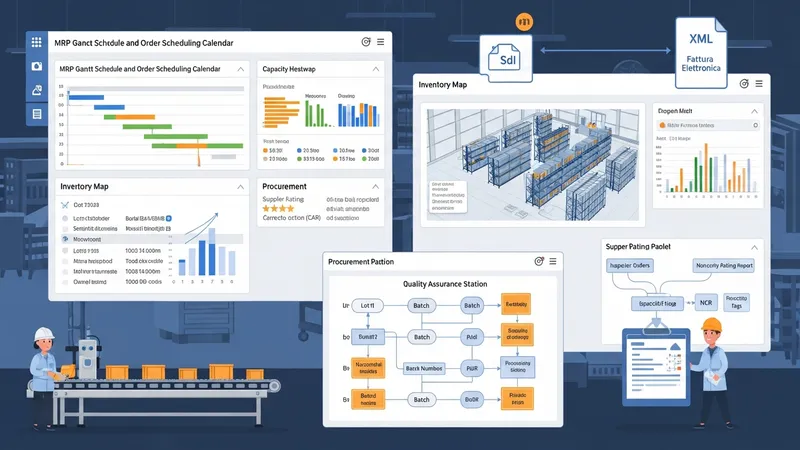
When comparing feature sets, Italian manufacturers may consider traceability and electronic invoicing compatibility as part of core coverage. Traceability features that log batch numbers and process steps may support compliance in food or medical supply chains. Electronic invoicing (fatturazione elettronica) is widely adopted in Italy, and ERP systems often provide modules or connectors to format and transmit XML invoices via the Sistema di Interscambio (SdI). Vendors may supply prebuilt adapters or APIs to streamline this interaction.
Another aspect of feature coverage is support for shop-floor data collection and production execution. Typical approaches include barcode scanning, RFID, or direct machine integrations using OPC-UA or PLC interfaces; these can feed real-time status and yield information into the ERP. For manufacturers in Italy’s industrial districts, lightweight data collection aimed at small batch and artisanal processes can be as important as high-volume automation integrations, and modular systems may accommodate both patterns.
Customisation and configurability often determine how well an ERP fits specific manufacturing processes. Some systems provide low-code configuration tools to adjust workflows, forms, and rules without deep custom development. In Italy, where some plants balance legacy processes with modernisation goals, the ability to configure approval flows, localisation of language, and compliance reporting can be a practical consideration when assessing feature coverage.