
Industrial Automation Systems: Key Components And Functions In Manufacturing

Hardware components and their roles within manufacturing automation
Primary hardware elements include sensors, actuators, controllers, I/O modules, and operator interfaces. Sensors produce signals representing physical conditions; actuators—such as pneumatic cylinders, electric motors, and valves—translate control outputs into mechanical movement. Controllers read sensor inputs, run programmed logic, and issue commands to actuators; they may be centralized or distributed depending on system scale. I/O modules provide the physical connection points and often include signal conditioning. Operator interfaces (HMIs) present process information and accept manual inputs. Typical plant installations may include dozens to hundreds of I/O points per production line, with modular hardware used to simplify expansion and service.
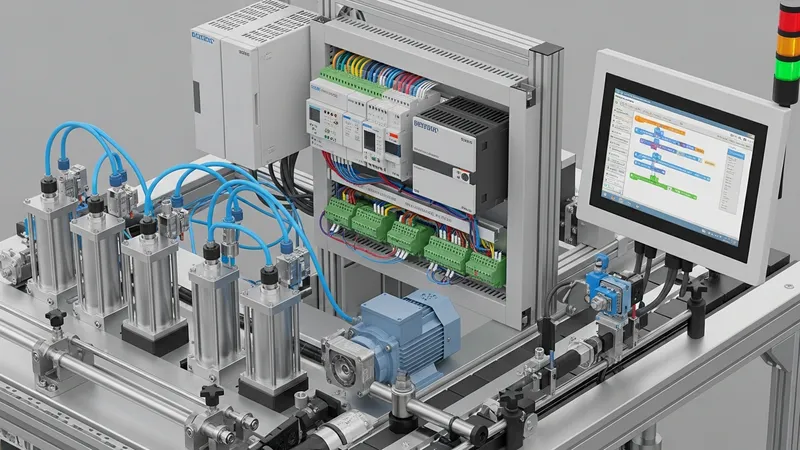
Controllers can be compact devices for machine-level tasks or part of a distributed control system for continuous processes. Programming approaches vary, commonly following standards for industrial control languages, and may include both simple relay-replacement logic and more advanced motion-control functions. Selection considerations often include cycle time requirements, environmental ratings, maintainability, and interoperability with existing equipment. Redundancy may be introduced in critical controller roles to improve availability, especially where process interruptions carry high cost or safety implications.
Sensors and actuators require attention to electrical and mechanical interfacing. Signal types may be analog (4–20 mA, 0–10 V) or digital (discrete, incremental encoders), and proper wiring, grounding, and shielding practices typically reduce noise and measurement errors. Actuator selection factors include force, speed, precision, and duty cycle. Mechanical mounting and access for inspection influence long-term reliability. Planning for spare parts and standardized connectors can often reduce downtime during replacements or repairs.
Installation and maintenance considerations for hardware commonly emphasize accessibility and modularity. Equipment racks, labelled wiring, and documented I/O maps facilitate troubleshooting. Environmental protection—sealed enclosures, cooling, and vibration mitigation—can extend component life in harsh production settings. These practical choices may influence lifecycle costs and should be evaluated as part of system specification rather than addressed only after deployment.