
Indoor Air Quality Sensor: Key Metrics Measured And What They May Indicate

Sensor types and measurement principles for Indoor Air Quality Sensor
Different measurement technologies address varied aspects of indoor environments. Optical particle counters use laser scattering to size and count particles and often convert counts to estimated mass concentrations for PM1.0, PM2.5, and PM10. Nondispersive infrared (NDIR) modules absorb infrared light at specific wavelengths to quantify carbon dioxide in parts per million. Electrochemical sensors detect gases such as carbon monoxide through chemical reactions that generate measurable current. Photoionization detectors (PIDs) ionize volatile organics using ultraviolet light, producing a signal proportional to the sum of ionizable compounds present. Each approach has trade-offs in sensitivity, selectivity, lifespan, and cost.
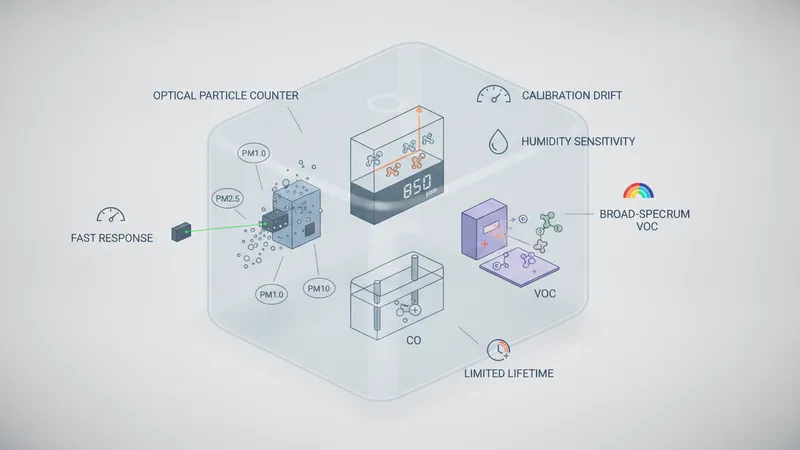
Performance characteristics commonly differ by technology. Optical counters typically respond rapidly to particle changes but may be influenced by particle composition and humidity when converting counts to mass. NDIR CO2 sensors are often stable for months but can exhibit calibration drift over long deployments or after exposure to high concentrations. Electrochemical cells for gases can have limited lifetimes and may require replacement at defined intervals. PIDs detect a broad VOC spectrum but do not easily differentiate individual chemicals without complementary sampling or lab analysis. Understanding these characteristics helps set expectations for data interpretation.
Selection for a given use case tends to match the parameter of interest to an appropriate sensing method. For occupancy and ventilation assessment, CO2 detection is frequently used because concentration trends may correlate with exhaled breath accumulation. For combustion or infiltration concerns, particle counters are often chosen to observe fine particulate trends. For detecting chemical emissions or off-gassing, PID or sorbent-based sampling followed by laboratory analysis may be appropriate. In many settings, integrated monitors that combine multiple sensor types may provide cross-relevant context without implying definitive identification of specific sources.
Practical considerations include sensor response time, detection limits, and environmental tolerances. Rapid response supports identifying transient events, while lower detection limits facilitate monitoring background concentrations. Temperature and humidity ranges influence sensor stability and may require compensation algorithms or protective enclosures. Power, data connectivity, and physical size also factor into deployments: battery-operated units can enable temporary assessments, whereas wired or networked instruments may be preferred for continuous integration into building management data streams. Readers may review manufacturer specifications and independent evaluations when assessing trade-offs.