
CPQ Software: Understanding Configure-Price-Quote Solutions For B2B Sales

CPQ Software: Understanding Configure-Price-Quote Solutions for B2B Sales — Configuration and Product Modeling
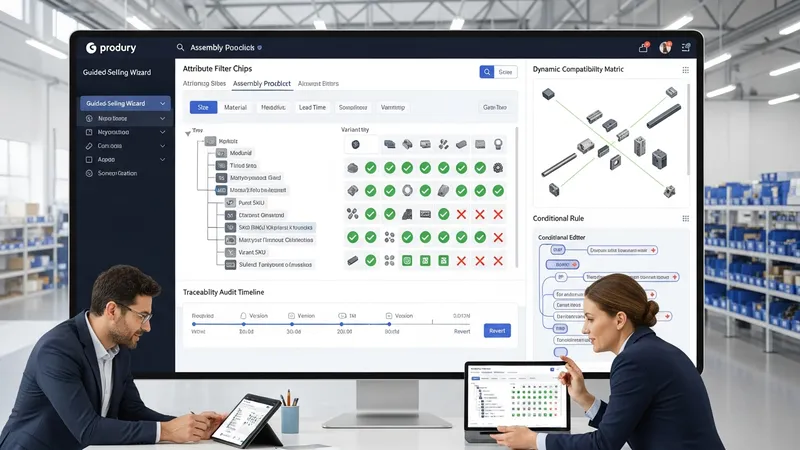
Product modeling within CPQ typically involves defining configurable attributes, option sets, and compatibility rules to represent complex offerings. In US manufacturing and distribution contexts, models often include nested assemblies and variant management so that a single product family can produce many distinct SKUs. Catalogs may be organized by attribute filters used by sales reps during guided selling. US firms frequently align configuration models with engineering or product management inputs to ensure that field-available options reflect current production capabilities and lead times.
Constraint management helps prevent invalid selections and can reduce engineering changes or order cancellations. Constraints are often expressed as conditional rules (if-then logic) or compatibility matrices that the CPQ engine evaluates during configuration. In larger US enterprises, configuration rules may be maintained in rule engines or business-rule management systems so that non-technical staff can update options. Traceability of rule changes is commonly implemented to support audits and to revert changes if they disrupt quoting accuracy.
Attribute-driven pricing links configuration choices to cost or price adjustments, enabling dynamic line-item calculations. For example, selecting a premium finish or additional module can automatically add specific charges or change lead-time assumptions. US organizations may also map configuration results to manufacturing BOMs that feed ERP systems for material planning. This mapping reduces manual translation errors between sales orders and production orders when a complex configuration becomes an executable order.
Testing and validation are typical parts of configuration management in CPQ projects. US teams often create representative test cases covering common configurations, edge cases, and prohibited combinations to validate rule execution. Automated testing approaches may be applied where available, and governance practices usually define change windows and rollback procedures to limit quoting disruptions. These operational controls can help maintain catalog integrity as products and pricing evolve.