
Container Housing: Future Trends In Modular Living And Urban Development

Container housing refers to residential structures that repurpose steel shipping containers into living spaces. In the United States this approach is discussed as a modular, adaptive construction method that may use single containers, multiple connected units, or stackable arrangements to form compact dwellings. Containers provide a defined structural shell that can be modified for doors, windows, insulation, and services, and builders often pair them with conventional building practices to meet local codes and occupant needs.
In U.S. urban contexts, container housing is considered alongside other modular techniques as a potential component of infill development, accessory dwelling units (ADUs), and temporary or transitional housing. Design choices typically address structural reinforcement, thermal performance, moisture control, and site logistics such as delivery and crane access. Discussion in planning and design circles often frames container housing as one set of modular options rather than a single solution.
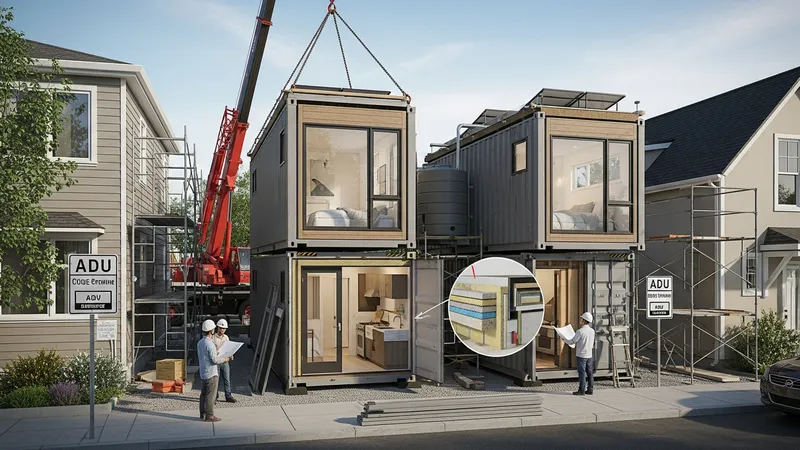
- Single-container microhomes — compact units using a single 20-foot or 40-foot container adapted for a studio layout, usually requiring interior insulation, ventilation, and basic utilities.
- Multi-container modular assemblies — two or more containers combined side-by-side or stacked to create larger floorplates and multi-room plans, often involving welding and added framing for openings.
- Container ADUs and infill modules — smaller secondary units placed on residential lots as accessory dwellings or infill housing, intended to fit local zoning and site constraints.
Container dimensions in the United States are commonly 20-foot and 40-foot lengths with standard widths, which influences layout and transport logistics. Converting a container may often involve cutting openings for doors and windows, reinforcing corners or cut areas, and adding a thermal envelope. Local permitting processes typically assess whether a container-based structure will be classified as a permanent dwelling, a manufactured unit, or a non-permanent structure—an outcome that can affect foundation requirements, inspections, and utility connections.
Thermal and moisture control are frequent technical concerns for container housing. Steel conducts heat and cold, so designers often add continuous insulation, thermal breaks, or interior framing to meet energy-code targets. Corrosion protection and proper ventilation are commonly noted as necessary to limit condensation and preserve structural integrity. In the United States, applicable energy and building codes are frequently enforced at the state or local level and may reference standards from the International Code Council (ICC) or state codes.
Site and logistical considerations commonly shape feasibility in U.S. cities. Transporting a 40-foot container typically requires truck access and may need permits for oversize loads; on-site crane lifts or forklifts can be necessary for placement. Foundation choices—pier, slab, or continuous—can influence whether a unit is treated as permanent real property. Utilities, stormwater management, and access for emergency services are additional municipal concerns that planners and permitting officials often review.
Affordability and lifecycle factors are discussed as contextual considerations rather than guarantees. Material reuse can reduce some embodied-materials impacts, but conversion and finishing costs, site work, and compliance with codes can add expense. Lifecycle performance with regard to energy use, maintenance, and adaptability to changing needs is often evaluated alongside conventional modular and stick-built alternatives when municipalities and developers consider policy or pilot projects.
In summary, container housing in the United States represents a modular construction approach that may be applied to microhomes, multi-container assemblies, and ADUs. Technical issues such as insulation, corrosion protection, and structural modifications commonly inform design and permitting. Regulatory classification and site logistics often determine feasibility in specific U.S. jurisdictions. The next sections examine practical components and considerations in more detail.