
Coding Basics: Core Concepts Shared Across Popular Programming Languages

Coding basics: Functions, scope, and debugging
Functions encapsulate behavior and typically accept inputs and return outputs; they are a primary unit of abstraction. Different languages support varying function features such as default parameters, named arguments, variadic parameters, and anonymous functions (lambdas). Understanding parameter-passing semantics — by value, by reference, or by sharing a reference — helps predict how changes inside a function affect callers. Breaking problems into small, testable functions can improve clarity and facilitate unit testing.
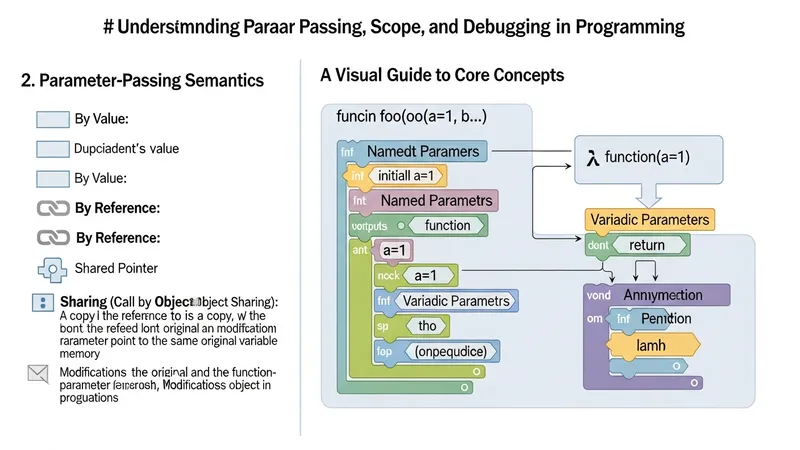
Scope rules determine where names are visible and how they are resolved. Lexical (static) scope, where a function’s environment is determined by its textual context, is common and supports closures when functions capture variables from enclosing scopes. Dynamic scope is less common but appears in some older or specialized languages. Awareness of shadowing, global state, and closure lifetimes is important to avoid unintentional interactions between modules and to reason about memory retention.
Debugging strategies include using interactive shells, logging, and step-through debuggers. Many language ecosystems provide REPLs that allow executing small code snippets and inspecting runtime state, which can accelerate experimentation. Structured logging with context and consistent error messages helps reproduce and analyze issues. Writing small, focused tests around functions can also surface regressions quickly and serve as an executable form of documentation for expected behavior.
Testing and basic verification complement debugging in producing reliable code. Unit tests, integration tests, and simple invariants asserted during development may reveal edge cases and guide refactoring safely. When porting logic between languages introduced earlier on the list — such as Python, JavaScript, and Java — translating tests alongside implementation can help confirm behavioral equivalence. These practices are considerations rather than prescriptions and may be adapted to the tooling available in each language’s ecosystem.