
Coding Basics: Core Concepts Shared Across Popular Programming Languages

Coding basics: Data types and operators
Common data type categories include numeric types, booleans, text, and structured types like arrays and objects. Numeric types often include integers and floating-point numbers with platform-dependent ranges that may influence calculations involving large values. Text handling typically requires awareness of encoding; many modern languages use Unicode by default but behavior around normalization and byte-level operations can differ. For structured types, the distinction between value semantics and reference semantics can affect copying and mutation patterns.
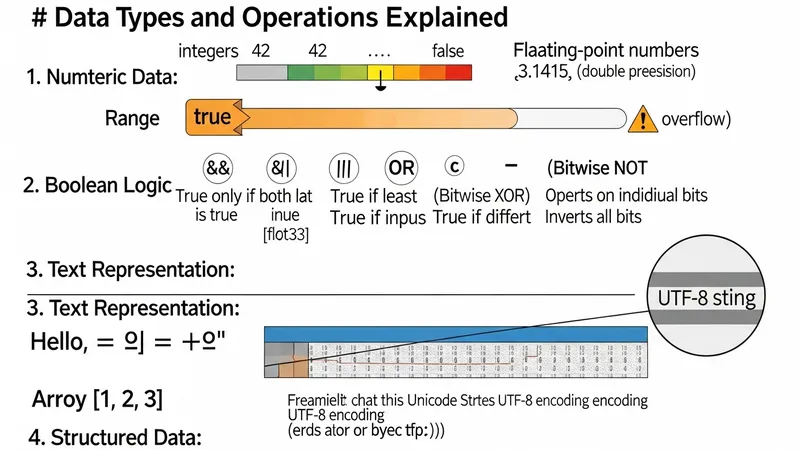
Operator semantics can vary in subtle ways across languages. Equality operators may compare value equivalence or identity differently; some languages provide separate operators for strict versus loose equality. Operator precedence and associativity rules determine how expressions are evaluated and can cause surprises when porting code. Bitwise and logical operators are available in most languages, but their use may be more idiomatic in systems programming versus application-level code.
Type conversion and coercion are practical issues when combining different data types. Implicit conversions can simplify code but also introduce ambiguity, particularly in dynamically typed environments. Explicit conversion functions or casting mechanisms are commonly available and often preferable when porting algorithms between languages, since they make intent clearer and reduce runtime surprises. When performance is a concern, understanding the cost of conversions and boxing/unboxing operations may be relevant.
Collections and iteration idioms are tightly linked to data types and operators. Languages may provide index-based arrays, linked lists, or higher-level sequence abstractions with associated operators for mapping, filtering, and reducing data. Familiarity with these idioms can lead to clearer code and sometimes more efficient implementations. When learning a new language, reviewing its standard library for collection utilities typically yields patterns that replace manual loops with concise, higher-level expressions.