
Artificial Intelligence In Cancer Treatment: Understanding Current Applications And Future Possibilities

Types of AI approaches used in cancer treatment
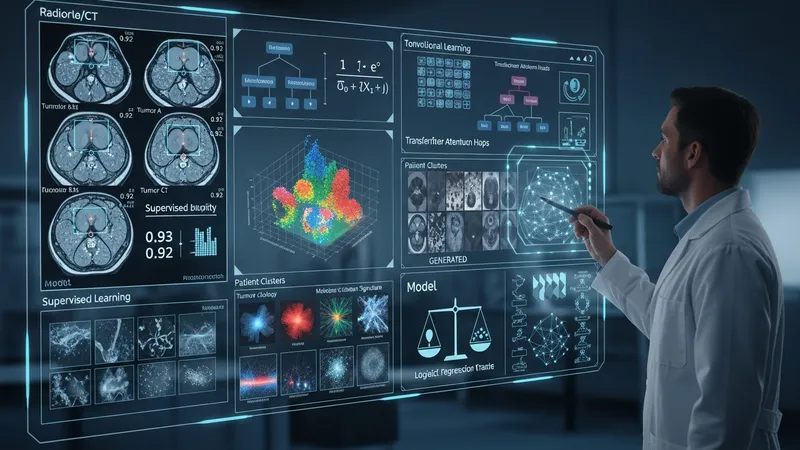
AI approaches in oncology broadly fall into supervised, unsupervised, and generative categories. Supervised learning commonly addresses classification and regression tasks such as tumor detection or outcome prediction using labeled examples. Unsupervised methods may identify previously unrecognized patient subgroups or molecular signatures by clustering high-dimensional data. Generative approaches, including variational autoencoders or generative adversarial networks, can simulate realistic biological or imaging data for augmentation or hypothesis exploration. Each approach may serve distinct research or clinical aims and is selected based on task requirements, available labeled data, and evaluation objectives.
Deep learning architectures, including convolutional neural networks and transformer models, are frequently used for image analysis and multimodal integration. These models can extract hierarchical features that may correlate with pathology or molecular states. Simpler models such as logistic regression or tree-based ensembles often remain relevant where data volume is limited or interpretability is a priority. Practitioners typically weigh trade-offs between model complexity, data needs, and the clarity of explanations provided to clinical users.
Multimodal AI systems combine imaging, genomics, and clinical data to build more comprehensive representations of a patient’s disease. Integration techniques range from early fusion—concatenating features before modeling—to late fusion—combining predictions from separate models. Multimodal models may capture interactions across data types that single-modality models miss, but they also often demand larger, well-annotated datasets and more complex validation strategies to ensure robustness across different data sources.
When choosing an AI approach, teams often consider data availability, regulatory expectations, and end-user needs. A useful consideration is whether a model must run in real time (e.g., intra-procedural imaging) or may operate offline for research purposes. Developers commonly pilot multiple architectures and emphasize transparent reporting of performance metrics, dataset composition, and limitations so that clinicians and researchers can judge applicability for specific tasks or populations.