
Artificial Intelligence In Cancer Treatment: Understanding Current Applications And Future Possibilities

Artificial intelligence (AI) in cancer treatment refers to computational systems that analyze clinical, imaging, and molecular data to support aspects of oncology care. These systems include machine learning models, deep learning networks, and statistical algorithms that process large datasets to identify patterns, assist with image interpretation, and generate quantitative predictions. The goal of such systems is to provide additional information to clinicians and researchers rather than to replace clinical judgment. AI applications are typically developed around specific tasks such as image segmentation, risk stratification, or biomarker discovery and are evaluated for performance against established clinical or laboratory standards.
AI in oncology often combines multiple data types—radiology images, pathology slides, genomics, and electronic health record entries—to form multimodal models that may reveal associations not evident from single-source analysis. Development commonly involves supervised learning from labeled datasets, unsupervised analysis to detect subgroups, and reinforcement or generative approaches for simulation or hypothesis generation. Implementation typically requires attention to dataset representativeness, model explainability, and integration into clinical workflows so that outputs are interpretable and usable by care teams.
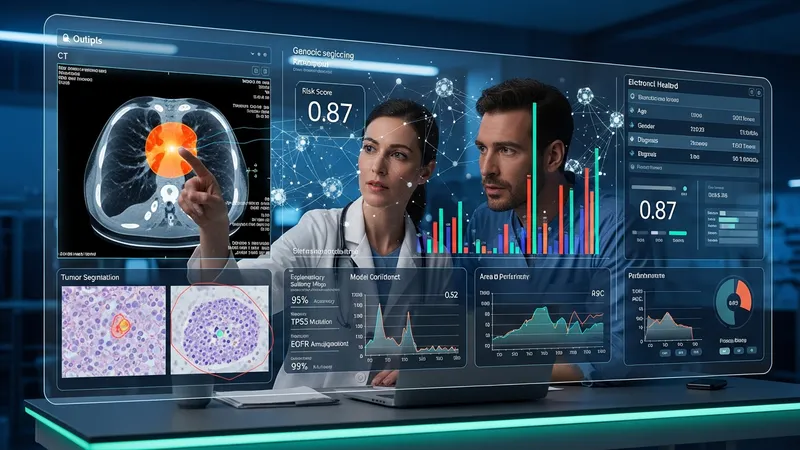
- Radiology and pathology image analysis — automated detection and quantification using convolutional and transformer-based architectures to assist interpretation of CT, MRI, PET, and digitized histology images.
- Predictive modeling for response and prognosis — statistical and machine learning models that use clinical and molecular features to estimate likely treatment response, adverse-event risk, or survival probabilities.
- Drug discovery and molecular screening — computational approaches including virtual screening, molecular property prediction, and generative models to identify candidate compounds or drug–target interactions.
Imaging-focused AI systems often concentrate on tasks such as lesion detection, segmentation, or radiomic feature extraction. These models may be trained on annotated images and validated against radiologist reads or histopathology. Imaging AI can serve in triage workflows or as quantitative second reads, and its performance typically depends on image quality, annotation consistency, and variation in scanner settings. When considering imaging AI, researchers and clinicians often evaluate sensitivity, specificity, and calibration across diverse patient populations to understand where models may generalize or require further refinement.
Predictive models that use clinical and molecular data often combine demographic, laboratory, and genomic variables to estimate outcomes such as treatment response or progression. Such models may use conventional regression techniques, tree-based ensembles, or neural networks. Their clinical value often depends on both statistical performance and interpretability: clinicians may prefer models that provide feature-level contributions or risk stratification thresholds that align with existing decision processes. Models may require external validation across independent cohorts before being considered for clinical use.
Drug discovery applications employ AI to prioritize chemical structures and biological targets that could be relevant to oncology. These methods can accelerate in-silico screening phases by predicting properties such as target affinity, toxicity liabilities, or synthetic accessibility. While AI can reduce the number of candidate compounds for laboratory testing, laboratory and preclinical assays remain essential to confirm biological activity and safety. Collaboration between computational chemists and experimental teams often shapes which AI-generated leads proceed to further evaluation.
Integration of AI into clinical workflows raises technical and organizational considerations. Data interoperability, electronic health record integration, and user interface design often determine whether an AI output is effectively used in practice. Prospective studies and pilot implementations may reveal workflow bottlenecks or user experience issues that retrospective evaluations did not capture. Stakeholders commonly assess whether model outputs are actionable, interpretable, and align with existing clinical pathways before broader adoption.
In summary, AI in cancer treatment encompasses imaging analysis, predictive modeling, and computational drug discovery, all of which may augment research and clinical processes when developed and validated with care. These systems typically perform task-specific analyses and require attention to data quality, external validation, and interpretability. The next sections examine practical components and considerations in more detail.