
AI Scheduling For Plumbing Businesses: How Automation Supports Job Booking And Dispatch

Scheduling algorithms and matching logic for appointment booking and dispatch
Scheduling algorithms used in plumbing service contexts typically include deterministic rule engines, constraint solvers, and predictive models that estimate task durations. Rule engines enforce explicit business constraints such as required certifications, parts availability, and mandated service windows. Constraint solvers may treat scheduling as an optimization problem that balances technician availability against required skills and customer time windows. Predictive elements can estimate how long a task may take based on historical records, which a scheduler may use to reduce overlaps or avoid excessive travel between assignments.
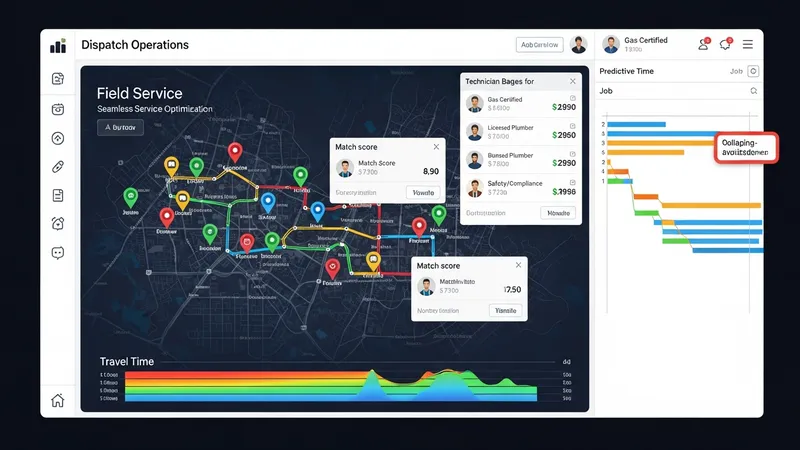
Matching logic often accounts for technician skills, licensure, tool availability, and geographic proximity. A typical approach assigns a higher match score when multiple criteria align—such as a technician already on a nearby call who has completed similar repairs previously. In practice, schedulers may apply weighted rules so that safety and compliance constraints override proximity-based preferences. Plumbers’ organizations commonly treat special assignments (e.g., gas-line work or complex diagnostic visits) as exceptions that require dispatcher approval rather than automatic assignment.
Routing and sequence optimization are core algorithmic steps once matches are suggested. Mapping and travel-time estimates use traffic models and distance matrices to sequence visits efficiently; some platforms recompute sequences in real time when a new urgent request arrives or when a technician reports delays. The trade-off between minimizing travel time and maintaining balanced workloads is often configurable, and operators typically choose settings that reflect local traffic patterns and workforce expectations.
When evaluating algorithmic approaches, it is informative to monitor schedule quality metrics such as on-time arrivals, reschedule frequency, and average travel time per technician. These metrics help calibrate rules and predictive components. Organizations often pilot new matching logic on a small subset of assignments before broad roll-out, monitoring outcomes and adjusting rule weights rather than assuming immediate improvement.