
AI In Manufacturing: Understanding Applications And Industry Use Cases

Industrial use of artificial intelligence refers to applying data-driven algorithms, machine learning, and related software to operational processes in factories and production systems. In this context, AI systems process sensor signals, machine logs, and enterprise data to detect patterns, infer equipment condition, and support decisions about maintenance, inspection, scheduling, and material flows. These systems typically integrate with programmable logic controllers, enterprise resource planning systems, and industrial networks so that analytical outputs align with control and planning workflows.
Implementation commonly involves structured data pipelines, model training on historical process records, and deployment on edge devices or cloud services for runtime inference. AI methods may include supervised learning for classification, unsupervised techniques for anomaly detection, and optimization algorithms for planning. Practical adoption often requires cross-functional collaboration among engineering, operations, data science, and IT teams to ensure data availability, model validation, and safe integration into production environments.
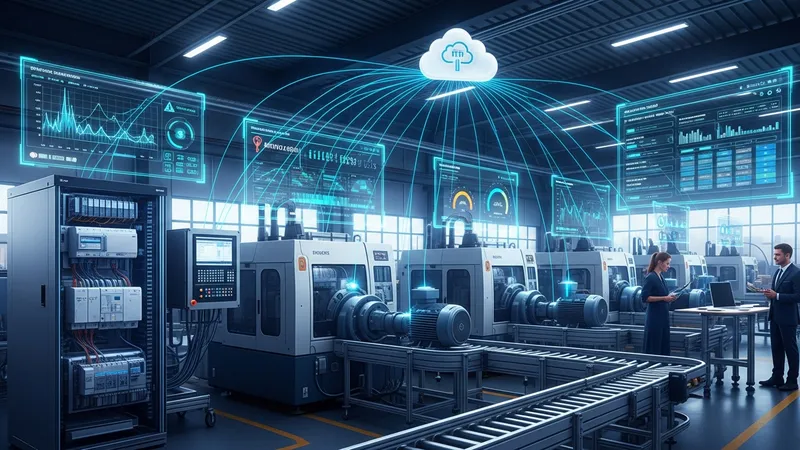
- Predictive maintenance using sensor fusion and machine learning — models that analyze vibration, temperature, and current to estimate equipment degradation and identify likely faults.
- Computer vision for automated inspection — image-based systems that use convolutional neural networks to detect surface defects, assembly errors, or label mismatches on production lines.
- Robotic automation with adaptive control — collaborative robots (cobots) and robot arms that may use learning-based motion planning or force control to support flexible assembly or part handling.
Predictive maintenance applications typically start with data collection from condition-monitoring sensors and historical maintenance records. Data preprocessing often includes filtering, feature extraction, and labeling of known fault events. Common predictive approaches may use time-series models, classification, or survival analysis to estimate remaining useful life or probability of failure within a given horizon. Practitioners often view model accuracy and false alarm rates as trade-offs; reducing false positives can avoid unnecessary interventions, while missing early signs may allow faults to progress. Integration with maintenance workflows and spare-parts inventory is frequently necessary for operational value.
Visual inspection systems often require annotated datasets that reflect real production variability, including lighting changes, part orientation, and acceptable tolerances. Transfer learning and data augmentation may be applied to reduce the volume of labeled examples needed. In-line inspection may run inference on edge devices to meet latency and bandwidth requirements, while higher-capacity training and model updates commonly occur on centralized servers. When deploying vision solutions, teams typically evaluate metrics such as detection rate and false-reject rate and plan for periodic retraining as process conditions shift.
Robotic automation combined with AI can support adaptive tasks where variability in parts or positions is present. Approaches include model-based control augmented by perception and data-driven planners that learn from demonstrations or simulation. Safety considerations are central: collaborative robots often operate with force-limited modes and require safety-rated sensors or fences depending on task risk. Scaling robotic solutions may involve assessing cycle time impacts, tool-change logistics, and the extent of human oversight needed to handle exceptions and non-routine tasks.
Production planning and supply-chain analytics often use optimization and forecasting methods that can incorporate AI-generated demand signals or supplier performance indicators. Forecasting models may combine historical demand, promotions, and external data streams to suggest production volumes, while optimization routines can consider capacity constraints and lead times. Interpreting model outputs within planning cycles requires clear interfaces and scenario analysis so planners can understand suggested schedules and contingencies. Data quality, latency, and the alignment of business rules with model outputs are frequent implementation considerations.
AI applications in manufacturing involve technical, organizational, and operational components that together determine practical outcomes. Data readiness and governance commonly influence the pace at which specific use cases move from pilot to sustained operation. Technical choices about edge versus cloud inference, model explainability, and human-in-the-loop validation often shape where and how systems are adopted. The next sections examine practical components and considerations in more detail.