
Professional Network Advertising Platforms: Understanding Targeting And Audience Segmentation

Professional network advertising platforms are digital systems used to place promotional content within environments that serve working professionals and industry communities. These systems commonly provide interfaces for defining who should see an ad based on attributes such as job role, company size, industry sector, seniority, and stated professional interests. The platforms typically combine deterministic profile fields (self-reported job title, employer) with behavioral signals (content interactions, group memberships) to enable more focused delivery than many general social networks.
These platforms often support campaign-level controls for audience segmentation, bid settings, and creative variation so that advertisers can align messaging with defined professional cohorts. Audience building tools may include saved segments, lookalike audiences derived from seed lists, and exclusion rules to avoid overlap. Reporting modules usually present metrics on impressions, engagement, and conversions tied to defined segments, which can inform iterative adjustments to targeting and creative choices.
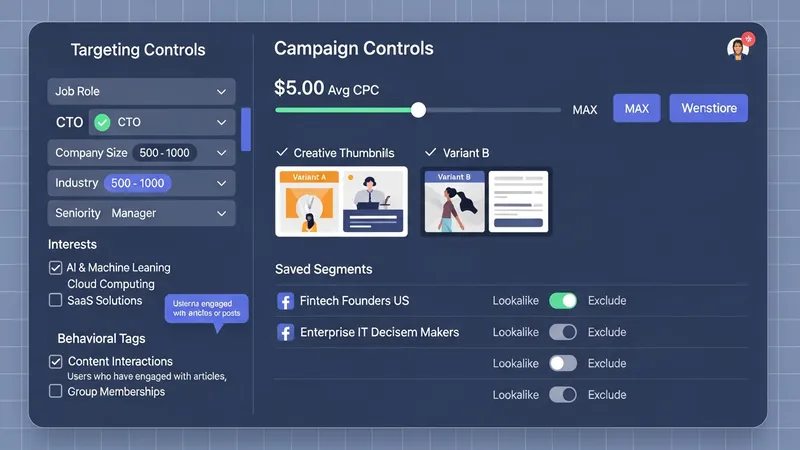
- LinkedIn Campaign Manager — Platform-level targeting for job title, company, industry, and skills; commonly used for B2B outreach and professional audience segmentation.
- Stack Overflow Advertising — Contextual and audience-based placement within developer and technical Q&A content; often used when technical skills or developer roles are relevant to segmentation.
- Glassdoor Employer Advertising — Employer-branded and job-related ad placements where targeting may align with company reviews, job seekers’ intent, and employer-specific audience segments.
Targeting dimensions on professional networks may be organized into hierarchical layers that combine broad filters with narrower attributes. For example, a campaign might start by limiting delivery to employees at companies of a certain size, then refine to specific departments or seniority bands. Platforms may allow Boolean logic (AND/OR/NOT) when composing segments, which can reduce wasted impressions but also add complexity. When constructing segments, analysts often balance specificity against audience scale to maintain statistical validity for performance measurement and optimization.
Data sources used for segmentation usually mix profile data, platform interactions, and inferred interests. Profile data tends to be deterministic and stable (job title, company), while interaction data (content likes, group memberships, page follows) can indicate current interests or transient priorities. Some platforms augment these with third-party behavioral signals or conversion tracking pixels to connect on-platform exposure to off-platform actions. Practitioners often treat inferred signals as probabilistic inputs that may require validation through A/B testing or lift studies.
Segmentation workflows may include audience definition, seed-list import, lookalike expansion, and exclusion lists to avoid overlap across campaigns. Seed lists are often uploaded as hashed identifiers to preserve privacy and then matched to platform profiles for custom audience creation. Lookalike methods typically derive attributes from a seed population and expand reach to similar users while retaining core characteristics. Careful naming conventions and documentation help teams track which segments were used in which experiments and avoid redundant spending on overlapping audiences.
Measurement approaches on these platforms frequently emphasize engagement metrics (click-through rates, video completion) alongside conversion events that map to professional outcomes (lead form submissions, demo requests, content downloads). Attribution windows and event definitions can vary, so analysts often align platform reporting with internal analytics through shared conversion tags or server-side integrations. Because professional intent can be multi-step and prolonged, measurement plans commonly include time-based windows and cohort analyses rather than single-touch attributions.
In summary, advertising systems that operate within professional contexts provide layered targeting and segmentation tools that combine deterministic and inferred data. These systems may support seed lists, lookalike expansion, and campaign controls intended to align creative with specific professional cohorts. The next sections examine practical components and considerations in more detail.