
Vertical SaaS For Construction: How Industry-Specific Software Supports Project Delivery

Construction-focused software delivered as industry-specific cloud services organizes project data, communication, and administrative workflows in ways tailored to building and civil projects. These platforms concentrate on tasks such as schedule tracking, cost budgeting, document control, change management, and field reporting, aligning toolsets to typical construction roles (project managers, superintendents, estimators, and owners). The software often includes mobile access for field personnel, structured repositories for drawings and submittals, and workflow engines for approvals that reflect construction project lifecycles rather than generic business processes.
Deployments for construction tend to emphasize integrations with accounting systems, plan viewers, and on-site capture tools, enabling teams to maintain a shared record of decisions and deliverables. Industry-specific features commonly include RFI (request for information) tracking, punchlist management, and change-order workflows. In United States practice, these platforms may also support documentation needed for contract compliance, permitting, and lien or retention processes, while providing role-based access controls to separate field and office responsibilities.
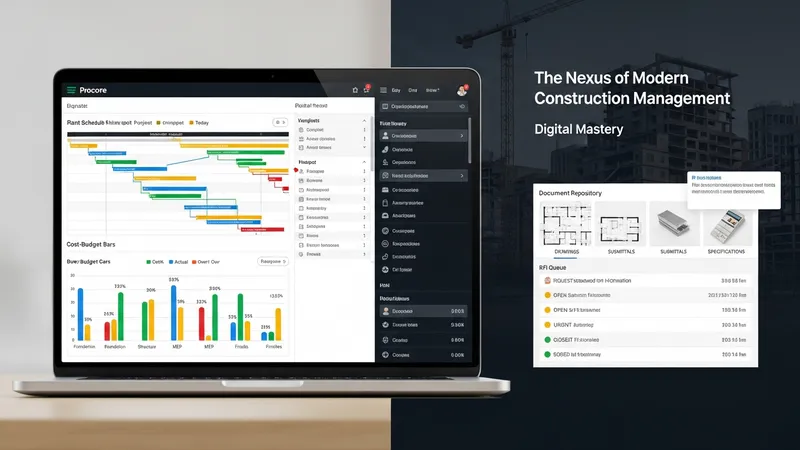
- Procore — A U.S.-based construction management platform focused on document control, RFIs, submittals, and project-level collaboration across general contractors and specialty contractors.
- Autodesk Construction Cloud — A set of construction workflow tools that connect design data and field execution, including model viewing and drawing management often used in U.S. projects that reference BIM workflows.
- Buildertrend — A cloud platform commonly used by home builders and remodelers in the United States for scheduling, selections, client communication, and basic job costing.
Many construction organizations compare industry-specific clouds with generic project software by looking at workflow fit and data structures. Construction platforms typically provide preconfigured entities such as drawings, RFIs, and change orders that may reduce configuration time relative to general-purpose tools. They can also impose discipline on recordkeeping by attaching metadata (drawing revisions, dates, responsible parties) to each document. That said, adoption patterns vary across contractors in the United States: larger firms may prefer deeper integrations with enterprise finance systems, while smaller contractors may prioritize mobile field entry and simplified cost tracking.
Integration capabilities often determine how effectively a construction platform supports delivery. Common integrations include accounting systems (for payroll and lien waivers), subcontractor portals (for bid and payment workflows), and model viewers (for geometric coordination). File formats such as DWG and IFC are frequently exchanged between design and construction tools in U.S. projects that use building information modeling (BIM). Interoperability considerations may influence whether a firm centralizes data in a single platform or uses a hub-and-spoke approach where a core system exchanges data with specialised tools.
Field adoption and user experience are practical considerations that can affect project outcomes. Mobile forms, offline capabilities for areas with limited connectivity, and simplified interfaces for foremen or inspectors may increase the consistency of data captured on site. Usage patterns in the United States often reflect workforce composition and project scale: residential remodelers may adopt different feature sets than heavy-civil contractors. Training and governance are commonly needed so that data entered in the field aligns with office workflows for estimating, billing, and compliance.
Security, access control, and document retention also shape how these platforms support delivery. Construction records can be relevant for contract disputes, permitting, and payment processes; consequently, U.S. contractors may require audit trails and exportable archives. Role-based permissions and single sign-on options may be used to limit exposure of sensitive financial or personnel data. Vendors and project teams often negotiate data ownership clauses and export formats during procurement to ensure that historical project records remain accessible after contract transitions.
Overall, these industry-focused cloud tools aim to align digital workflows with construction practice rather than general office workflows. They may streamline coordination between design and field teams, clarify document revision status, and centralize communication tied to project deliverables. The next sections examine practical components and considerations in more detail.