
Financial Technology Trends: Key Innovations Reshaping Banking And Payments

Recent developments in financial technology describe the evolving set of tools and infrastructure that change how banks, payment processors, and users exchange value in the United States. These developments include software-driven banking interfaces, digital wallets on mobile devices, distributed ledger systems for recordkeeping, and automated services that handle account reconciliation and risk monitoring. The core idea is a shift from manual, paper-based, or legacy-system processes toward programmatic, internet-native systems that can alter transaction flows, data integration, and customer interactions.
In the U.S. context, this shift often involves interoperability between traditional banks and newer technology providers, standardized application programming interfaces (APIs), and updated operational practices for fraud detection and compliance. Financial institutions and technology firms may adopt cloud services, tokenization for card credentials, and machine learning models for anomaly detection. These changes typically affect payment rails, settlement timing, and the user interfaces through which consumers and businesses initiate transfers.
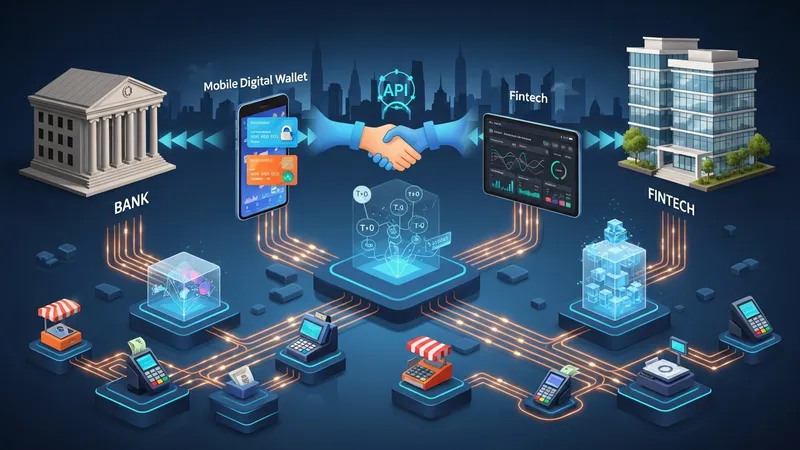
- Apple Pay — a mobile wallet and tokenization service that allows consumers to store payment credentials on iOS devices and authorize transactions with device-level authentication.
- Google Pay — a U.S. market mobile payment and digital wallet option that integrates with Android devices and supports contactless payments and peer transfers.
- Stripe — a payments infrastructure provider used by U.S. merchants to accept card and online payments with developer-focused APIs and reporting tools.
- Plaid — an API connectivity service that links consumer financial accounts with applications for verification, balance checks, and transaction history access in U.S. banking contexts.
Comparison across these examples shows different functional roles: mobile wallets primarily focus on consumer-facing credential storage and in-person contactless payments, payment processors provide merchant-facing transaction routing and settlement, and connectivity platforms enable account-level data exchange between institutions and third-party applications. In the United States, settlement times, interchange rules, and network access can vary by rail and provider, and integration choices may influence reconciliation complexity and operational cost structures.
Infrastructure choices may also affect compliance and risk frameworks. For example, using tokenization and device-based authentication can reduce exposure to certain card-data vulnerabilities, while integrating third-party APIs requires contractual and technical controls to manage data sharing. Regulators such as the Federal Reserve, the Consumer Financial Protection Bureau (CFPB), and the Securities and Exchange Commission (SEC) may be relevant depending on whether a service touches deposits, consumer protections, or securities-related activity.
Technical trends often manifest as modular approaches: banks may adopt cloud-native core processing, deploy microservices for payment orchestration, or use machine learning models hosted in controlled environments for transaction monitoring. These architectural choices can make feature rollout and third-party integration more predictable, though they also require attention to data residency, vendor management, and disaster-recovery planning under U.S. regulatory expectations.
From a market adoption perspective, consumer-facing mobile wallets and merchant-facing payment processors have seen broad uptake in many U.S. retail and e-commerce segments, while distributed ledger initiatives may be more prevalent in pilot and settlement use cases within capital markets and interbank messaging. Each innovation typically brings trade-offs in cost, latency, and operational complexity that institutions evaluate according to their customer base and transaction volumes.
In summary, recent fintech developments in the United States encompass device-level wallets, API-based data connectivity, payment-processing platforms, and emerging distributed ledger tools. These components can interact in various configurations to support faster authorization, automated reconciliation, or alternative settlement arrangements. The next sections examine practical components and considerations in more detail.