
Pumps And Fluid Handling Equipment: Key Types, Applications, And Selection Factors

Pumps and fluid handling equipment are mechanical systems that transfer liquids or mixtures through pipelines and process systems. In practical terms, these assemblies include the moving elements, drive systems, seals, and wetted materials that determine how a liquid moves under pressure and velocity constraints. Describing the concept involves clarifying how device type, power source, and construction materials relate to the fluid’s properties — for example, whether it is clean water, an abrasive slurry, viscous oil, or a sanitary food product. Technical parameters such as flow rate, discharge head, and allowable solids content typically define suitable classes of equipment.
Design and selection also consider operational context: intermittent versus continuous service, temperature range, regulatory hygiene or containment requirements, and access for maintenance. In industrial and municipal settings within Italy, these considerations intersect with local building practices, regional water authority requirements, and national standards. Equipment may be driven by electric motors, diesel engines, or hydraulic power and can be mounted as close-coupled units, between-bearing assemblies, or in mobile frames for site work.
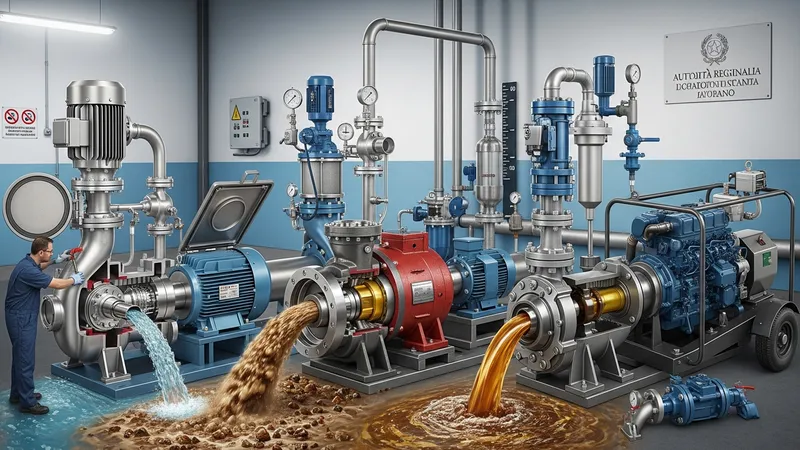
- Centrifugal pumps — common for low-viscosity liquids with moderate solids; typically used for water supply and circulation. Typical Italian market price ranges for small to medium units may vary from approximately €100–€10.000 depending on capacity and construction.
- Positive displacement pumps (gear, lobe, screw) — suited to viscous or metered flows and where constant volumetric output is needed; typical ranges may be around €500–€8.000 for industrial models in Italy.
- Diaphragm and peristaltic pumps — used for abrasive slurries, chemical dosing, and hygienic applications where leakage must be minimised; Italian market examples often fall in the range of €200–€6.000 depending on size and materials.
Comparing these examples, centrifugal units often provide higher flow at lower pressures by converting rotational energy into kinetic energy, while positive displacement devices deliver a fixed volume per cycle and may handle higher viscosities more predictably. Diaphragm and peristaltic types isolate the fluid from mechanical drives, which can reduce contamination risk and simplify compliance with food or pharmaceutical hygiene requirements. In Italy, selection frequently references national norms and industry practice when matching pump hydraulics to process demands.
Material compatibility and corrosion resistance commonly influence choice in Italian facilities. For instance, AISI 304 or 316 stainless steels are typically used in the food and beverage sector to meet sanitary expectations, while cast iron or duplex stainless may be selected for municipal water and wastewater pumps. Where abrasive solids are present, designers often consider hardened alloys, ceramic coatings, or replaceable wear parts. These material trade-offs may affect capital cost and service life simultaneously.
Energy use and driving arrangements are practical considerations that can significantly affect life-cycle costs. Electric motor efficiency levels and the use of variable frequency drives (VFDs) may reduce electricity consumption for modulating flow, a factor increasingly monitored in Italian industrial energy management plans. Conversely, remote or temporary sites sometimes use diesel-driven pumps, which entail different maintenance and emissions considerations under Italian environmental regulations.
Maintenance access, spare parts logistics, and local technical support are frequently decisive in Italian procurement choices. Domestic manufacturers and local distributors often provide shorter lead times for replacement parts and service visits, which may reduce downtime risk for continuous processes such as municipal water supply or food processing lines. Conversely, specialised or custom pumps may have longer delivery times and require planned spare inventories.
In summary, pumps and fluid handling equipment are chosen by balancing fluid properties, hydraulic requirements, material compatibility, energy considerations, and local service arrangements. In Italy, these factors interact with national standards, sector-specific hygiene or environmental rules, and the availability of local technical support. The next sections examine practical components and considerations in more detail.