
Small Business Liability Insurance: Key Coverages And What They May Protect

Small businesses often carry liability insurance designed to respond to third-party claims for bodily injury, property damage, and legal defence costs arising from operations, products, or professional services. Such policies typically define the scope of covered incidents, the limits available for payment, and conditions under which the insurer will provide a defence. Coverage intent is to address losses that a business could be held legally responsible for under civil liability rules, with contract terms that describe covered perils, exclusions, and settlement processes.
In practical terms, these liability arrangements are modular: a small firm may hold one or more policy types that together address different exposures. Policies are written with specified limits and often with deductibles or retentions; some are “occurrence” based while others are “claims-made.” The contract language, endorsements, and state insurance regulations influence how and when coverage may apply. Understanding common coverage categories and typical policy features can help clarify which incidents a business may expect to be within policy scope.
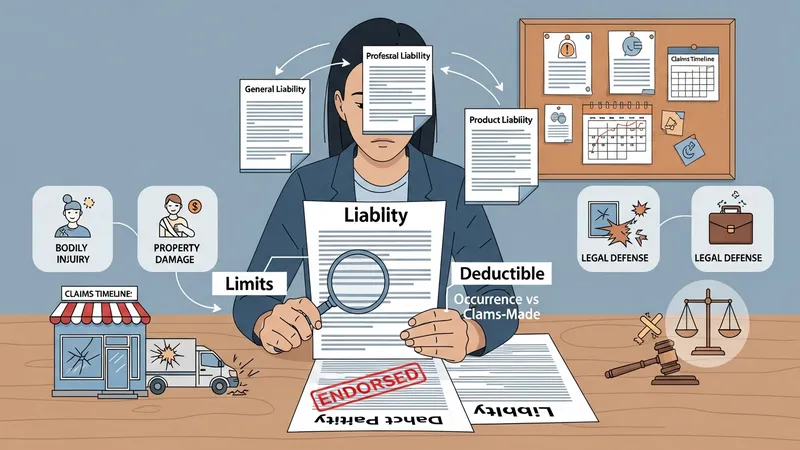
- Commercial General Liability (CGL) — Broadly addresses third-party bodily injury and property damage at business premises or due to operations; may also include advertising injury and legal defence costs in many U.S. policies.
- Professional Liability / Errors & Omissions (E&O) — Targets claims arising from alleged errors, omissions, or negligent professional services for firms that provide advice or technical services.
- Cyber Liability — Addresses third-party loss exposures from data breaches, privacy events, and associated notification or liability costs; commonly used by businesses handling customer data in the U.S.
Policy limits and the way defence costs are handled can materially affect how protections operate in practice. Many U.S. policies specify a per-occurrence limit and an aggregate limit for the policy term; defence costs may be paid inside or outside those limits depending on policy wording. Endorsements can alter coverage scope, for example adding liability for contractors on a project or excluding specific risks. State insurance departments and neutral industry summaries often explain typical policy structures for small businesses in familiar terms.
Exclusions and conditions commonly narrow coverages in predictable ways. Intentional acts, criminal conduct, and certain professional services are often excluded from general liability forms and addressed instead via specialized policies. In the U.S., some sectors—construction, food service, retail—face industry-specific exclusions or endorsements. Understanding the typical exclusions and the way they interact with endorsements may clarify where gaps could exist and whether additional policy types, such as product liability or employment practices liability, may be relevant.
Cost factors for liability protection vary with business characteristics and may influence coverage choices. Underwriting often considers industry classification, annual revenue, payroll, premises exposures, claims history, and the presence of safety or loss-control measures. For small firms, annual premiums for general liability are often reported across a wide range—from several hundred dollars to multiple thousands of dollars—depending on these factors and on coverage limits selected. Estimates should be interpreted cautiously and viewed as illustrative rather than definitive.
When evaluating coverage, the relationship between limits, deductibles, and contractual requirements is important. Some clients or landlords in the U.S. may request certificates of insurance specifying minimum limits or additional insured endorsements, which can affect policy selection. Similarly, umbrella or excess policies can extend aggregate and per-occurrence limits above primary coverage layers. These structural choices can change the amount potentially available for settlements and legal defence when a covered claim arises.
In summary, liability insurance for small firms is organized into defined coverage types with policy language that determines when claims may be addressed and how losses and defence costs are allocated. Coverage choices and endorsements may influence the presence of gaps or overlaps, and underwriting factors typically drive premium variation. The next sections examine practical components and considerations in more detail.