
Solar Installation Services: Key Steps And Considerations For Residential And Commercial Projects

Solar installation services in the United Kingdom generally refer to the process of fitting solar photovoltaic (PV) panels onto residential, commercial, or industrial rooftops or ground mounts to capture sunlight and convert it into usable electricity. These services encompass several procedures, including site assessment, system design, panel installation, electrical integration, and regulatory compliance. Solar installations are typically carried out by qualified companies that follow national standards and regional guidelines to ensure safety and optimized energy production.
The process of a solar installation service involves various professionals, such as surveyors, designers, certified electricians, and customer support teams. Companies planning installations in the United Kingdom may need to evaluate each property for solar suitability, taking into account factors like roof orientation, shading, local weather conditions, and any planning permission requirements. Service providers may vary in their installation approach depending on whether the property is residential, commercial, or part of a large industrial site.
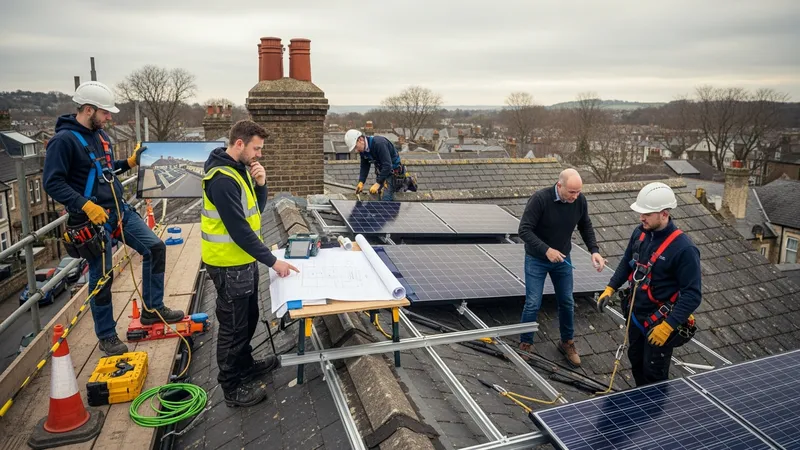
- Site Survey and Solar Assessment: A trained surveyor may perform an evaluation of the site to determine its solar potential. This step typically involves measuring the roof area, identifying possible shading sources, and assessing the property’s structural suitability for panels.
- System Design and Quotation: Engineers or designers usually create a tailored solar PV layout, selecting appropriate panel types and inverters, and providing an estimated system output and quotation based on current market prices in the UK.
- Installation and Electrical Integration: Certified installers handle the mounting of solar panels, wiring, and connection to the property’s electrical system. All work should meet standards such as those set by the Microgeneration Certification Scheme (MCS) in the United Kingdom.
Solar installation services may differ between residential and commercial projects. Residential installations often involve rooftop solar panels sized to fit the household’s energy needs and usually require minimal construction beyond panel mounting and inverter installation. Commercial installations, by contrast, can involve larger or more complex systems, sometimes spread over multiple buildings or configured to support higher energy loads. These differences may affect both the timeline and the scope of works needed on-site.
Regulatory compliance is a crucial aspect of solar installations in the United Kingdom. Installers typically follow national standards as set by the MCS and may also help clients apply for local council permissions when required. Some installations qualify for incentives such as the Smart Export Guarantee (SEG) which allows excess generated electricity to be sold back to the grid after connection approval by the District Network Operator (DNO).
Choosing a service provider may depend on factors like experience with similar property types, membership in professional accreditation schemes, and a transparent approach to system sizing and energy output estimates. Pricing may vary, with recent figures for residential installs in the UK generally ranging from approximately £5,000 to £8,000 for standard 3–4kW systems, depending on property specifics and component choices.
Technological advancements may influence the types of panels and inverters offered by service providers. Some companies may offer battery storage or smart-energy monitoring solutions, which are increasingly sought after for managing energy usage or maximizing self-consumption. Such components add complexity to the installation service and may require specialist expertise.
In summary, the solar installation process in the United Kingdom encompasses a series of coordinated steps: site evaluation, system design, installation, and compliance. Each stage is significant for ensuring safety, operational reliability, and regulatory adherence. The next sections examine practical components and considerations in more detail.