
Workforce Management Software: Key Features And Core Functions Explained

Workforce management software is a category of enterprise applications designed to coordinate staffing, attendance, and related operational processes. These systems typically combine scheduling, timekeeping, leave tracking, and forecasting functions into a unified interface so that managers can align staff availability with demand, monitor labor usage, and maintain records for payroll and regulatory purposes. The software may integrate with point-of-sale terminals, access control, or payroll engines to reduce duplicate data entry and to maintain a single source of workforce information for administrative and analytical use.
At a functional level, such solutions often include tools for creating and distributing schedules, recording hours worked, managing requests for time off, and estimating future staffing needs based on historical patterns. They may also provide compliance checks that reference local labor rules and configurable approvals for exceptions. Reporting modules commonly extract operational metrics—such as hours per role, planned versus actual coverage, and variance in labor costs—to support decision making rather than to drive automatic personnel actions.
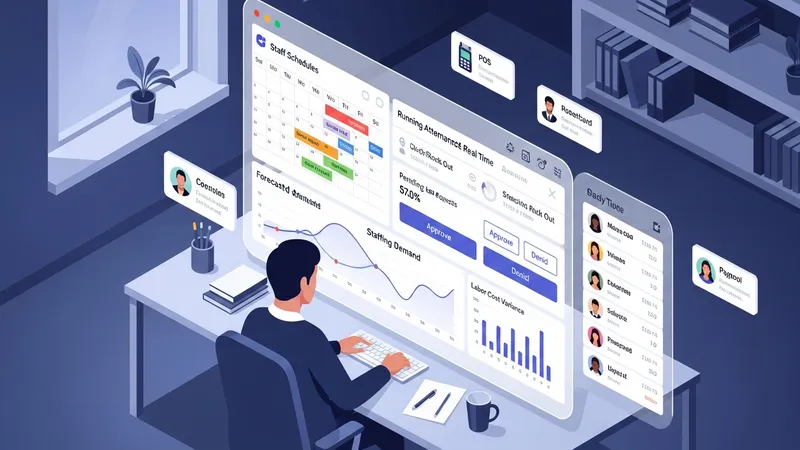
- Employee scheduling modules — interfaces for shift creation, shift swapping, and coverage visualization that aim to align available staff with planned shifts while preserving payroll inputs.
- Time and attendance platforms — systems that record clock-in/out times, calculate worked hours and overtime exposure, and export validated time data to payroll or HR records.
- Forecasting and analytics tools — modules that analyze historical demand and labor patterns to generate staffing forecasts, scenario comparisons, and trend reports for planning purposes.
Comparative frameworks for these tools often separate capabilities into operational, administrative, and analytical tiers. Operational capabilities include rostering and real-time attendance; administrative capabilities cover time approvals, leave administration, and payroll interfaces; analytical capabilities provide dashboards and forecasting. Organizations may select combinations of these tiers to match scale and complexity: smaller operations often prioritize basic scheduling and attendance capture, while larger operations typically add advanced forecasting and rule-based compliance checks. Each capability set may require different levels of configuration and data hygiene to produce reliable outputs.
Integration considerations are commonly central to deployments because workforce systems typically need identity and payroll data to function as intended. Integration points often include HR information systems, payroll processors, and access control or point-of-sale systems where time stamps originate. Data mapping and consistent identifiers for employees and roles usually reduce reconciliation work. When integrating, teams frequently test end-to-end payroll runs and exception cases to ensure time capture flows correctly into downstream accounting or personnel records before full production use.
Rules and compliance features in these systems are frequently configurable to reflect local labor laws, collective bargaining terms, or company policies. Configurable rules may cover overtime thresholds, minimum rest periods between shifts, and eligibility for specific shift differentials. Because legal requirements vary by jurisdiction and may change, responsible users commonly review and update rule sets periodically; some vendors provide template rule libraries that can be adapted. Audit trails and exception reports are typically included so organizations can document decisions and corrections for regulatory review.
Data quality and governance often determine how useful workforce management outputs are in practice. Accurate role definitions, up-to-date employee status, and consistent time capture practices typically improve forecast reliability and reduce payroll disputes. Reporting accuracy often depends on clear policies for time rounding, break handling, and approval workflows. Organizations may adopt staging environments and sample datasets to validate logic and reporting before applying configurations to live operations, which can reduce downstream corrections and administrative overhead.
In summary, enterprise workforce coordination software brings together scheduling, timekeeping, leave administration, forecasting, and reporting functions to help organizations align staff with demand while maintaining administrative records. The modular nature of these systems means features may be adopted incrementally and configured to match operational complexity. The next sections examine practical components and considerations in more detail.