
Wastewater Recycling: Key Processes And Treatment Stages Explained

Wastewater Recycling: Tertiary Treatment, Membrane Filtration and Disinfection
Tertiary treatment and advanced polishing steps are applied when reuse applications demand lower suspended solids, reduced nutrients or removal of micropollutants. Filtration options include sand or multimedia filters and cartridge systems for particulate reduction. Chemical coagulation and flocculation are often paired with filtration to target colloidal material. When very high-quality effluent is required, membrane processes such as microfiltration, ultrafiltration, nanofiltration or reverse osmosis may be used to achieve fine particle and dissolved constituent separation. Membranes require careful attention to pretreatment and cleaning protocols to manage fouling.
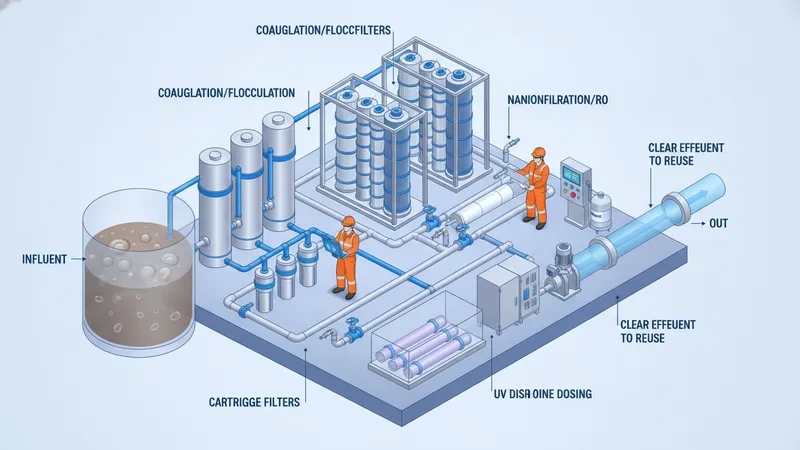
Disinfection is typically applied after tertiary polishing to control pathogens before distribution or reuse. Common methods include ultraviolet irradiation, chlorination and, in some systems, ozone. The selection among these often considers efficacy against target organisms, formation of disinfection by-products and operational complexity. For example, ultraviolet systems may avoid chemical residuals but require control of turbidity and regular lamp maintenance. Chlorination provides a residual that can protect distribution networks but may form regulated by-products under certain water chemistries.
Membrane systems and advanced oxidation approaches bring specific operational considerations. Membrane fouling can be mitigated by enhanced pretreatment, periodic backwashing and chemical cleaning; energy consumption and concentrate management also factor into lifecycle costs. Advanced oxidation processes may be used to degrade micropollutants and are typically energy- and reagent-intensive. When specifying tertiary and advanced units, designers commonly evaluate lifecycle implications including energy use, chemical handling and safe disposal or reuse of brine or spent chemicals.
Quality assurance for these stages commonly involves continuous or grab sampling of turbidity, particle counts, residual disinfectant and specific micropollutants depending on reuse intent. Inline monitoring tools can provide rapid detection of performance lapses, enabling operators to isolate faults or trigger corrective actions. Planning for redundancy in critical polishing steps may reduce the risk of accidental discharge of inadequately treated effluent to reuse systems.