
Waste Recycling Machinery: Key Types Of Equipment And How They Operate

Many recycling facilities rely on specialized industrial equipment to process discarded materials into forms suitable for sorting, recovery, and shipment. This category of machinery includes machines that reduce size, compact, convey, and separate materials according to physical properties. The equipment is typically integrated into a sequence of material-handling stages that begin with intake and end with prepared bales, pellets, or separated fractions ready for secondary use.
At the operational level, each machine fulfills a specific mechanical or physical function: size reduction to increase surface area, densification to reduce volume, and separation to isolate target fractions by weight, magnetism, color, or density. Machines may be arranged in series and controlled to balance throughput rates, with sensors and basic automation commonly used to coordinate flow and reduce manual sorting effort.
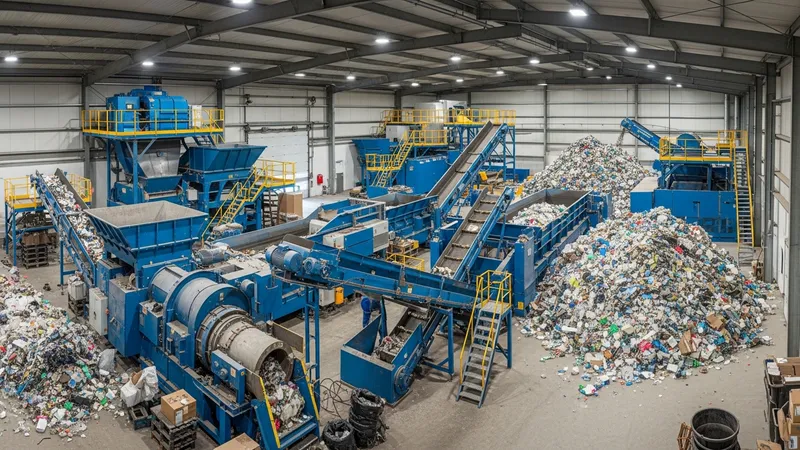
- Shredders — Mechanical size-reduction units that cut, tear, or shear materials into smaller pieces to facilitate downstream sorting and processing.
- Balers — Compression systems that compact materials such as paper, cardboard, or plastics into dense bales for transport and storage while reducing volume.
- Separators (magnetic, air, optical) — Devices that sort materials by properties such as magnetism, density, particle size, or optical characteristics to produce distinct material streams.
Shredders and crushers often serve as the first active processing stage because reducing particle size can improve the efficiency of subsequent separation methods. Shredders may use rotary cutters, shearing blades, or hammer mills depending on material toughness and desired fragment size. Typical considerations when selecting a size-reduction approach include the feed composition, moisture content, contamination level, and how the reduced-size product must perform for the next stage, such as screening or magnetic separation.
Balers and compactors focus on volume reduction and handling economics. By compressing loose recyclables into uniform bales, these machines make storage and transport more efficient and can protect material quality during transit. Different baler designs—vertical, horizontal, and closed-chamber—may be chosen based on throughput and bale density needs. Integration with conveyors and automated feeding systems can reduce manual labor and stabilize the supply rate into downstream processing.
Separation methods often combine mechanical, pneumatic, and sensor-based systems. Magnetic separators remove ferrous metals, eddy-current separators work for non-ferrous metals, air classifiers separate light and heavy fractions, and optical sorters use sensors to identify material types by color or spectral signatures. These techniques may be applied in stages so that coarse separation is followed by finer sorting, which can improve purity without excessive processing time.
Conveyors, hoppers, screens, and feeders form the material-handling backbone that connects individual machines into a coherent workflow. Conveyor speed, incline, and width influence throughput and the ability of separation equipment to function correctly. Screens—such as trommels or vibrating sieves—can pre-classify material sizes before a shredding or separation step, potentially reducing wear on primary processors and improving overall efficiency.
Automation and controls provide coordination across the processing line. Sensors that monitor flow rates, motor loads, or contamination levels may be used to adjust speeds, trigger diversion gates, or signal maintenance needs. Such feedback systems often reduce downtime and can help maintain material quality by avoiding overfeeding or excessive recycling of fines. Automation is typically scaled to facility size and budget, and may be added incrementally.
In summary, industrial recycling workflows rely on a combination of size-reduction, compaction, conveying, and separation equipment that each perform defined mechanical or physical tasks. Machines are usually selected and arranged to match the feedstock characteristics and desired output quality, and they may be linked with sensors and control systems to stabilize throughput. The next sections examine practical components and considerations in more detail.