
Tech Tools For Business: Understanding Digital Solutions For Modern Operations

Tech Tools for Business: Understanding Digital Solutions for Modern Operations refers to the range of software and platforms that support daily organizational activities. This concept covers systems used for communication, task coordination, customer relationship management, finance, analytics, cloud storage, and security. The focus is on how these digital solutions function together to enable routine operational processes, streamline workflows, and provide structured data for decision-making rather than on any single vendor or marketing claim.
These digital solutions may be delivered in different models, such as cloud-hosted services, managed platforms, or self-hosted installations, and they often include APIs, integration points, and administrative controls. They typically serve specific operational roles—communication, project tracking, customer records, accounting, marketing, or infrastructure—and may be combined to address broader business requirements. Understanding their capabilities, constraints, and common deployment patterns helps clarify how they contribute to modern operations.
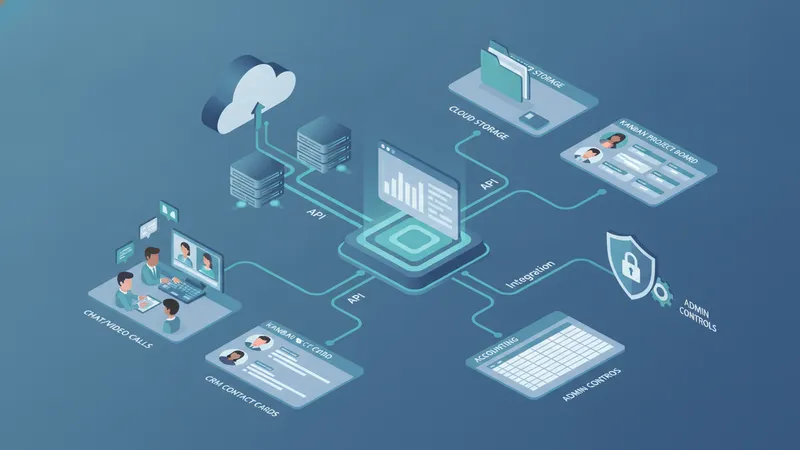
- Communication platforms — tools for messaging and video collaboration (examples include Slack and Microsoft Teams) that centralize team conversations and often provide integrations with task and calendar systems.
- Project and task management tools — platforms for planning and tracking work (examples include Asana and Trello) that provide work breakdowns, status tracking, and workflow rules to coordinate teams.
- Customer relationship management (CRM) systems — software for recording customer data and interactions (examples include Salesforce and HubSpot) that support sales pipelines, contact histories, and basic reporting functions.
Integration between these categories may occur through native connectors, third-party middleware, or custom APIs. When systems communicate, they exchange structured data such as user records, task statuses, and transactional entries. Typical integration patterns include event-driven updates, scheduled synchronizations, and direct API calls. Organizations often balance the benefits of tighter integration—faster data flows and reduced duplicate entry—against the complexity and maintenance overhead that connected architectures can introduce.
Deployment models influence operational and administrative responsibilities. SaaS offerings may offload infrastructure maintenance but often require ongoing subscription management and attention to configuration settings. Self-hosted solutions may give more control over data locality and customization but can increase the need for in-house maintenance and backups. Hybrid approaches frequently appear in practice, where critical data remains on controlled systems while non-sensitive functions use third-party cloud services.
Security and compliance considerations typically shape technology choices and configurations. Organizations commonly evaluate access controls, encryption in transit and at rest, logging, and role-based permissions when selecting tools. Compliance frameworks (such as privacy or sector-specific standards) may require data handling rules and retention policies that affect how tools are configured and how integrations are implemented. Risk assessments can help identify which systems require tighter governance.
Operational measurement and reporting often rely on aggregating data from multiple tools into dashboards or reporting platforms. Standard metrics may include task throughput, customer response times, invoicing cycles, and resource utilization. Tools that expose APIs or offer exportable datasets may simplify reporting, while platforms with limited data access can complicate analysis. Careful planning of data schemas and field mappings often reduces manual reconciliation during reporting.
In summary, understanding digital solutions for modern operations involves recognizing categories of tools, how they integrate, and the trade-offs between control, maintenance, and ease of use. Considerations around deployment models, security, and data access typically guide practical decisions. The next sections examine practical components and considerations in more detail.