
Tax-Efficient Wealth Management: Core Principles For Reducing Tax Drag On Investments

Managing an investment portfolio with attention to tax outcomes involves arranging accounts, security types, and transaction timing so that taxes take a smaller share of long‑term returns. The concept centers on recognizing how federal tax rules affect dividends, interest, short‑ and long‑term capital gains, and distributions, then choosing accounts and instruments that align with those rules. This approach often considers retirement accounts, tax‑exempt instruments, and taxable brokerage accounts together rather than separately, because the placement of assets and the holding period for positions can materially influence after‑tax outcomes.
Key aspects include selecting the appropriate vehicle for each asset class, using holding periods to qualify for preferential capital gains rates, and applying loss recognition rules in a way that offsets realized gains when appropriate. In the United States, taxpayers commonly reference IRS rules on retirement accounts, capital gains, and wash‑sale adjustments when planning. These regulatory anchors define what is allowable and what administrative steps (reporting, basis tracking) typically accompany tax‑aware choices.
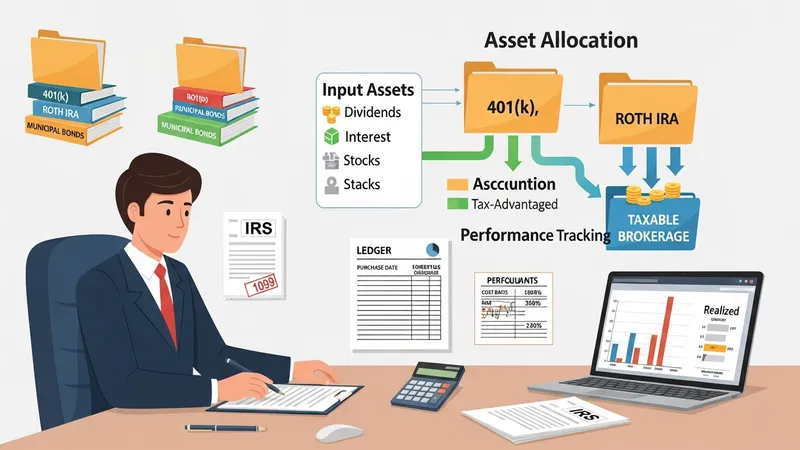
- Roth individual retirement accounts (Roth IRAs) — Contributions are after tax and qualified distributions may be tax‑free; often used for assets expected to appreciate substantially.
- Employer retirement plans (401(k), Roth 401(k)) — Tax‑deferred or after‑tax options used to shelter income from current taxation until distribution.
- Exchange‑traded funds (ETFs) and index funds — Broadly used for tax efficiency in taxable accounts because of in‑kind creation/redemption mechanisms that may reduce taxable distributions.
Asset location is a principal framework in this area: placing tax‑inefficient assets (taxable interest, actively traded bond funds) inside tax‑deferred or tax‑exempt accounts while holding tax‑efficient equity exposures (index funds, ETFs) in taxable accounts may often reduce annual taxable events. This placement strategy typically recognizes that bonds produce ordinary income taxed at federal rates, whereas qualified dividends and long‑term capital gains may receive preferential rates. United States taxpayers often compare the marginal federal tax treatment across account types to decide placement, while also accounting for state tax implications where relevant.
Holding period decisions affect whether a sale results in short‑term or long‑term capital gains. In the U.S., many taxpayers may qualify for reduced federal rates on long‑term capital gains and qualified dividends if a position is held beyond one year; therefore, turnover and trade frequency can create “tax drag” by converting potential long‑term gains into short‑term income. Tax‑aware managers frequently measure turnover and consider tax implications when evaluating active strategies, while noting that investor circumstances and tax brackets can alter the numerical impact.
Tax‑loss harvesting is an often‑discussed tactic that involves realizing losses in taxable accounts to offset realized gains or up to a specified amount of ordinary income per year, with excess losses carried forward. Application in the United States requires careful attention to the wash‑sale rule, which may disallow a loss if the same or substantially identical security is repurchased within 30 days. Publication 550 and IRS guidance outline these constraints, and investors may use diversified replacements or ETFs to maintain market exposure while attempting to preserve tax loss benefits.
Municipal bonds and municipal bond funds are frequently used for tax reduction in taxable accounts because interest from certain municipal securities may be exempt from federal income tax and, in some cases, state tax for residents of the issuing state. However, after‑tax yield comparisons and credit risk need to be weighed carefully: tax exemption does not eliminate credit risk or market risk. Investors commonly compare taxable equivalent yields and consult FINRA or other neutral sources for tax‑exempt bond characteristics.
Tradeoffs exist between deferring tax in retirement accounts and realizing tax‑free growth in Roth vehicles; for some U.S. taxpayers, converting assets into Roth accounts via conversions or contributing to Roth options may reduce taxes in later years but can generate current tax liability. These decisions typically depend on expected future tax rates, distribution timing, and individual circumstances. The next sections examine practical components and considerations in more detail.