
Remote Patient Monitoring Devices: Understanding Connected Health Technologies And Their Uses

Remote patient monitoring devices are electronic tools that collect physiological or behavioral data outside traditional clinical settings and make that data available to care teams. These systems typically combine sensors that measure signals such as heart rate, respiratory rate, blood pressure, oxygen saturation, activity, or glucose levels with connectivity components that transfer readings to software platforms. Data may be visualized on clinician dashboards, routed into electronic records, or subjected to automated analytics. The overall concept centers on capturing objective measurements in the home or ambulatory environment to inform clinical decisions and ongoing care processes.
Key elements of these connected health setups include the measurement hardware, local gateways (smartphones, hubs), secure transmission channels, and back-end platforms that support storage, visualization, and alerts. Devices vary by form factor and intended use: some are continuous wearable sensors, others are episodic home devices used at scheduled intervals. Implementation typically involves defining monitoring parameters, thresholds for clinician notification, and workflows for device provisioning, maintenance, and data review. Considerations often include battery life, user interface simplicity, and methods for validating data quality.
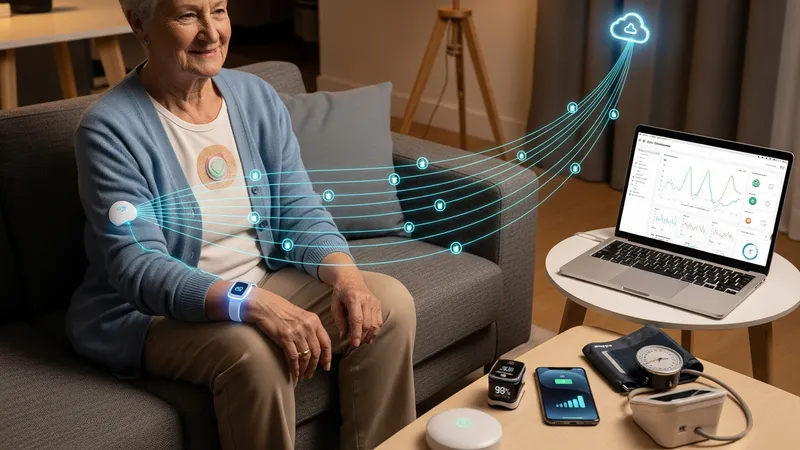
- Wearable vital-sign sensors — small form-factor devices such as chest patches, wristbands, or adhesive sensors that continuously record parameters like heart rate, respiratory rate, or activity levels; often designed for ambulatory monitoring and may use Bluetooth or cellular connectivity.
- Home point-measurement devices — internet-enabled blood pressure cuffs, pulse oximeters, glucometers, and weight scales that capture episodic readings and upload results through a paired hub or mobile app.
- Integrated gateway systems — bedside hubs or smartphone applications that aggregate multiple sensor inputs, manage device pairing, and forward encrypted data to cloud platforms for clinician access and analytics.
Sensors and measurement modalities differ in sampling frequency, calibration needs, and susceptibility to motion or environmental artifacts. Optical sensors that estimate pulse and oxygen saturation may be sensitive to skin tone, motion, or ambient light, while cuff-based blood pressure monitors rely on cuff fit and positioning. Validation against clinical-grade references is commonly recommended for devices intended to influence care decisions. In practice, device selection may weigh trade-offs between continuous monitoring and convenience: continuous devices can reveal trends and transient events, while episodic devices may be simpler for routine measurements in chronic-condition follow-up.
Data transmission pathways can shape reliability and latency. Bluetooth-connected sensors commonly pair to a smartphone app that acts as a gateway; cellular-enabled devices transmit directly to cloud services without a separate phone; Wi-Fi devices may be cost-effective in the home but depend on local network stability. Interoperability standards such as FHIR or HL7 often guide how monitoring data is structured for integration with electronic health record systems, but practical integration can involve middleware, APIs, and mapping work to align device outputs with clinical documentation and workflows.
Clinical applications tend to cluster around chronic disease management, post-discharge monitoring, and perioperative surveillance. For chronic heart failure, weight and symptom trends taken remotely may often supplement in-person assessments; for diabetes, remote glucose readings can inform dose adjustments in some clinical contexts; for respiratory conditions, home spirometry and pulse oximetry may contribute to longitudinal assessment. Monitoring programs typically define alert thresholds and escalation protocols so that data triggers result in a documented clinician response, rather than passive collection without follow-up.
Device lifecycle and operational management are significant practical concerns. Provisioning includes secure pairing, patient education, and baseline checks; ongoing support covers battery replacement or charging, firmware updates, and replacement of malfunctioning units. Security controls typically include device authentication, encryption in transit and at rest, and role-based access to dashboards. Regulatory frameworks and local privacy rules may influence data retention, consent, and reporting obligations. These operational layers often determine the feasibility and sustainability of a monitoring program as much as the sensor performance itself.
In summary, connected monitoring solutions combine sensors, gateways, data transport, and software to enable observation of physiological markers outside clinics. Device selection, data pathways, clinical workflows, and operational management each contribute to how monitoring data may be used in care processes. Implementation planning may therefore address validation approaches, integration with health records, and procedures for escalation and technical support. The next sections examine practical components and considerations in more detail.