
Metal Roofing: Key Materials, Styles, And Applications Explained

Metal roofing refers to roof coverings made from metal panels or shingles that serve as the outer weather-resistant layer of a building. These systems are manufactured from a range of metals and are formed into different profiles designed to shed water, accommodate roof slope, and interface with flashing and ventilation elements. Metal roofing may be used on both low-slope and steep-slope roofs; specific panel profiles and fastening methods are selected to match structural conditions, local climate, and aesthetic preferences. The term encompasses materials, panel styles, coatings, and installation approaches that together determine performance and lifecycle characteristics.
Key aspects that define a metal roofing system include the base metal (for example steel, aluminum, copper, or zinc), the panel or shingle profile, the method used to secure panels to the roof deck, and surface treatments or coatings applied for corrosion resistance and reflectivity. Panels can be manufactured in continuous lengths or modular sections, and seams may be mechanically seamed, crimped, or fastened through the face. These components interact with roof underlayment, fasteners, flashing, and roof penetrations; design choices often aim to balance durability, maintenance needs, and thermal or acoustic performance.
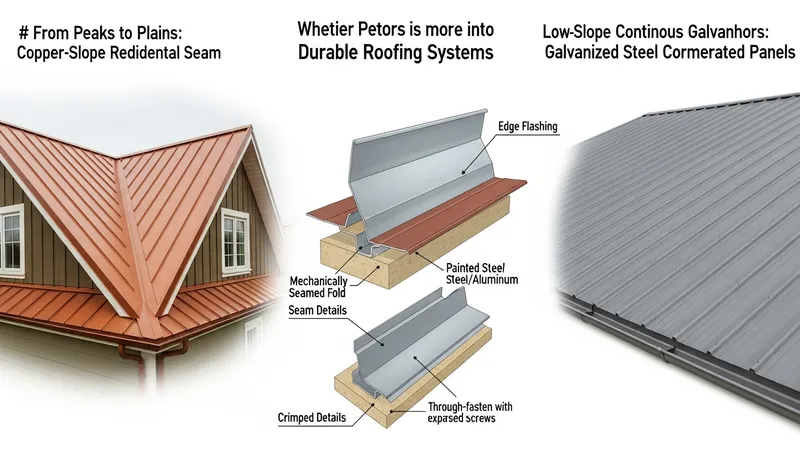
- Standing seam panels — Long, interlocking metal panels with concealed fasteners; often used where water shedding and reduced leak potential are priorities.
- Corrugated and ribbed panels — Through-fastened profiles with exposed fasteners; often used for simple roof decks and industrial or agricultural buildings.
- Metal shingles and tiles — Modular, overlapping units that mimic other roofing materials (shingles or tiles) while using metal as the base material.
Steel is a widely used base metal and is often supplied in coated forms such as galvanized or galvalume to resist corrosion; it typically offers strong structural properties and cost-effectiveness. Aluminum is lighter and resists corrosion in coastal or saline environments; it may be selected where weight reduction is relevant. Copper and zinc are more corrosion-resistant in many environments and develop natural patinas over time, which can be desirable for certain architectural applications but often involves higher material costs. Choice of base metal may also influence fastener selection, panel attachment details, and expected maintenance patterns.
Surface coatings applied to metal roofing commonly include organic paint systems and inorganic metallic coatings. Fluoropolymer-based paints (for example, PVDF-type finishes) may be applied for improved color retention and resistance to chalking over time, while silicone-modified polyesters can be a lower-cost painted option. Metallic coatings such as zinc or zinc-aluminum alloys are applied at the mill to provide a sacrificial corrosion layer on steel substrates. Coating selection can affect thermal emissivity and solar reflectance, which may influence building energy performance when combined with insulation and ventilation strategies.
Panel profiles and attachment methods affect waterproofing and wind performance. Standing seam systems use interlocking seams and concealed clips that permit thermal movement, potentially reducing stress on fasteners. Through-fastened panels secure directly to the deck with exposed fasteners and rely on proper washer detail and overlap to manage leaks; these are often simpler to install. At penetrations and eaves, flashing details and sealant compatibility must be considered to manage water run-off and ice/snow conditions. Each profile and method may be more or less suitable depending on roof slope, wind exposure, and local precipitation patterns.
Thermal and acoustic performance of metal roofs may be influenced by substrate, underlayment, insulation, and ventilation rather than the metal alone. Reflective coatings and lighter colors can increase solar reflectance and reduce heat gain in warm climates, often affecting peak cooling loads. Conversely, insulation strategies and air barriers beneath the roof deck determine conductive heat transfer and condensation risk. Acoustic perception of rain or hail on a metal roof may vary; adding insulation or sound-damping layers can alter interior noise levels without changing exterior performance characteristics.
When assessing suitability, consider life-cycle factors such as expected service life of the base metal and coating, maintenance intervals for fastener checks and sealant renewal, and potential trade-offs between upfront material and installation costs versus longer-term durability. Metal roofing systems may be applied across residential, commercial, and industrial buildings; selection often reflects structural capacity, desired appearance, and climate considerations. The next sections examine practical components and considerations in more detail.