
Legal Workflow Automation: Streamlining Document Management And Review Processes

Automation applied to the management and review of legal documents refers to using software-driven rules and structured processes to handle routine tasks across a document’s lifecycle. This includes capturing submitted paperwork, applying metadata, routing items to relevant reviewers, and enforcing standardized review steps. The objective is to reduce repetitive manual steps, increase consistency in how documents are handled, and make the status of files more visible to legal teams and stakeholders.
Such automation typically layers process logic on top of existing document repositories and communication channels. It can include form-based intake, conditional routing based on metadata, automated notifications, and staged approvals. These systems often integrate with search indexes and version controls so that users can find prior drafts, view change histories, and inspect who approved or rejected a step. The overall approach is procedural rather than prescriptive, and implementations may vary by firm size, practice area, and regulatory requirements.
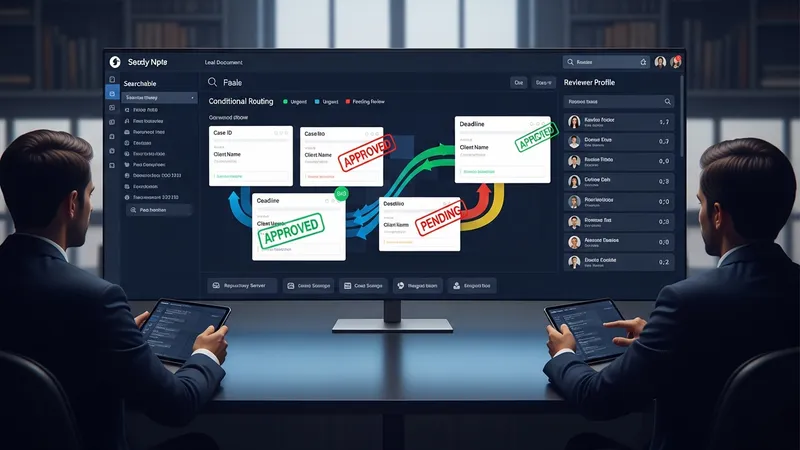
- Document management platforms with workflow modules — systems that combine storage, metadata tagging, and rule-based routing to standardize how documents move through review.
- Automated intake and triage tools — form capture, optical character recognition (OCR), and initial classification engines that assign documents to queues or matter codes.
- AI-assisted review workflows — tools that may extract clauses, suggest redlines, or flag inconsistencies to support human reviewers during contract or disclosure review.
When comparing approaches, organizations often consider where automation will reduce time spent on repetitive tasks versus where human judgment is essential. For example, automating intake and metadata tagging can often cut manual classification work, while final legal review typically remains a human responsibility. Implementation frameworks commonly start with mapping existing manual steps, identifying decision points that can be codified, and piloting automation on a narrow set of document types. This phased approach may help teams measure effects on throughput and error rates before broader rollout.
Security and compliance are frequent considerations when automating legal document processes. Controls such as role-based access, audit logs, and encryption are often included to support confidentiality and chain-of-custody requirements. In regulated sectors, retention schedules and redaction capabilities may be integrated so that automation aligns with recordkeeping obligations. Teams typically document governance policies that describe permitted automation behaviors, who can change workflows, and how exceptions are handled to maintain accountability.
Integration with existing systems can influence the value and complexity of automation projects. Connectors to email, matter management, billing, or client portals may allow documents to flow with minimal manual intervention. Conversely, organizations sometimes encounter data silos or incompatible metadata schemas that require normalization work. Planning for integration often includes inventorying current repositories, defining canonical metadata fields, and specifying how external sources map into automated routing rules.
Measuring outcomes usually focuses on throughput and traceability rather than absolute claims of efficiency. Common metrics include cycle time for review, percentage of documents processed automatically, audit trail completeness, and frequency of rework due to version confusion. Teams often track these indicators over time to understand whether workflows are performing as intended and where tuning or retraining may be necessary. Observed gains in consistency can be context-dependent and may vary by document type and team practices.
In summary, automating legal document management and review consolidates routine capture, routing, and oversight tasks under rule-based and sometimes AI-augmented processes. Implementations often begin with targeted pilots, emphasize security and governance, and measure changes in cycle time and traceability. The next sections examine practical components and considerations in more detail.