
Lead Management System: How It Organizes And Tracks Prospective Customers

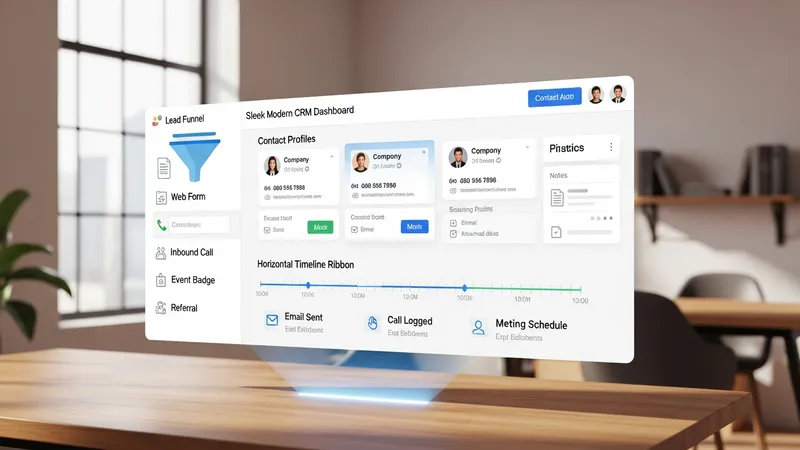
A system designed to capture and follow prospective customers collects contact details, records interactions, and maintains a timeline of engagement from first interest to a formal sales outcome. It centralizes incoming leads from web forms, inbound calls, events, and referrals, and links those leads to individual contact records and organization profiles. The system may also track source attribution, channel performance, and the sequence of touchpoints so that teams can observe where prospects are in a defined engagement process.
Such software typically includes tools for organizing leads into lists or stages, deduplicating entries, and attaching notes or documents to contact records. It often supports assignment rules so leads route to specific sellers or teams, and provides search and filtering to find prospects that match defined criteria. Integration with email, calendars, and advertising platforms may be available to ensure interactions are logged automatically and to reduce manual data entry.
- Salesforce CRM — enterprise-class customer relationship management platform commonly used for centralized lead records, customizable pipelines, and large-scale integrations.
- HubSpot CRM — widely used CRM that often includes contact tracking, basic automation, and marketing integration for capturing leads from inbound channels.
- Spreadsheet and web-form workflows — method using online forms that feed into spreadsheets or databases, often combined with scripts or lightweight automation to collect and organize leads where a full CRM is not in use.
Comparing these examples, systems may differ by scalability, data model, and integration depth rather than by a single measure of quality. Enterprise platforms often provide configurable objects and advanced automation for complex sales processes, while lightweight combinations of forms and spreadsheets may suffice for small teams or early-stage processes. Selection commonly reflects organizational size, expected lead volume, and whether the workflow requires tight integration with marketing or customer support systems.
Lead capture and enrichment are practical components that may reduce manual work. Capturing structured fields at first contact can standardize qualification indicators, and third-party enrichment services can append publicly available company or role information to incomplete records. These practices can increase contact completeness but may raise data quality and privacy considerations that organizations need to assess in context.
Qualification and scoring frameworks are often used to prioritize follow-up. A scoring model can combine demographic attributes, behavioral signals (such as downloads or page visits), and explicit responses to qualification questions. Scores typically guide routing and follow-up priorities, and organizations often calibrate thresholds iteratively so that scoring aligns with observed conversion patterns rather than fixed assumptions.
Reporting and visibility are typically central to operational use. Dashboards may show stage distribution, average time in stage, conversion rates between stages, and activity counts per team member. These metrics can inform process adjustments and resource allocation but should be interpreted with awareness of how data enters the system and which interactions are automatically captured versus those requiring manual logging.
In summary, a centralized approach to collecting, organizing, and tracking prospective customers provides structured records, routable workflows, and measurable pipeline visibility. Implementation choices often balance functionality, ease of use, and integration needs, and data quality and privacy practices may influence operating procedures. The next sections examine practical components and considerations in more detail.