
Industrial Noise Monitoring: Techniques For Measuring Workplace Sound Levels

Industrial environments commonly require systematic assessment of sound levels to document exposures, evaluate equipment noise, and support risk management. This process involves instruments, measurement protocols, and data analysis to quantify sound pressure levels across time and frequency. The objective is typically to provide an accurate, reproducible record of workplace acoustics so that controls, policies, or engineering responses can be informed by measured values rather than estimates.
Measurement activities may include spot checks near machinery, continuous monitoring in occupied areas, and personal monitoring worn by workers during specific tasks. Results are usually expressed using standard acoustic metrics and weightings that approximate human hearing, and measurements can be used to track trends, verify controls, or support compliance with applicable exposure limits.
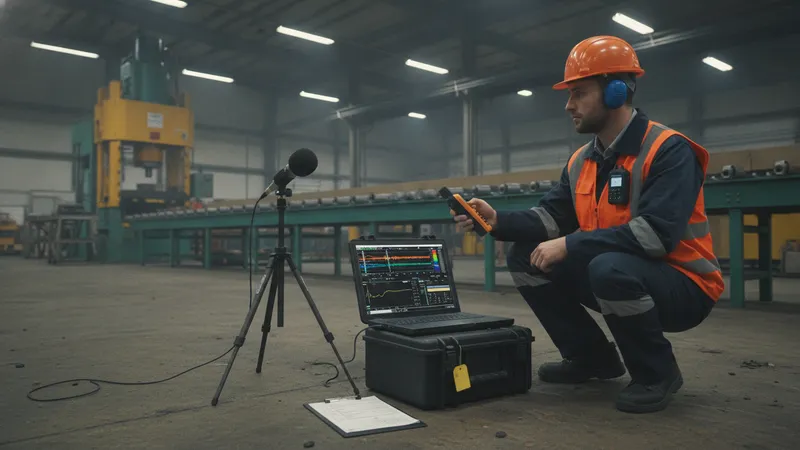
- Sound level meters — handheld instruments that measure instantaneous and integrated sound levels using standardized weightings (e.g., A-weighting). These devices typically record metrics such as LAeq, Lmax, and peak levels and may include data logging features.
- Personal dosimeters — wearable instruments designed to record an individual’s cumulative exposure over a shift. Dosimeters often calculate time-weighted averages and dose percentages to characterize exposure during normal work activities.
- Real-time monitoring and noise-mapping systems — systems that combine multiple sensors and software to produce spatial maps of sound levels across a facility or site. These tools can visualize hotspots and temporal patterns and may support long-term trend analysis.
- Frequency analyzers and octave-band analyzers — equipment that decomposes sound into frequency bands or spectra, which can be useful where tonal noise, equipment resonance, or audiometric effects are of interest.
- Acoustic calibrators and reference sources — portable calibrators used before and after measurements to verify instrument sensitivity and maintain traceability to reference levels.
Metrics and units used in workplace acoustic assessment typically include decibels (dB) with A-weighting (dBA) to approximate perceived loudness, as well as equivalent continuous sound level (Leq or LAeq) to represent average energy over a period. Peak sound levels and C-weighted measures may be recorded when impulsive or very loud events are present. Understanding which metrics are most relevant depends on the assessment purpose: exposure assessment often emphasizes time-weighted averages, while equipment testing may require spectral analysis.
Personal monitoring with dosimeters may be used when task variability affects an individual’s exposure. Dosimeters can often be configured with criterion levels and exchange rates that align with commonly cited occupational exposure frameworks; typical practice includes a full-shift sample and task-based logging for high-noise activities. For area measurements, placement and height relative to workers and machinery should be documented so that results are reproducible and comparable across sampling sessions.
Frequency analysis can clarify whether noise contains tonal components or energy concentrated in specific bands that may require engineering attention. Octave- or third-octave-band data often guide noise control design and selection of mitigation measures such as mufflers or enclosures. Spectral data may also inform audiometric considerations and help distinguish between broadband and narrowband sources when interpreting measurement results.
Calibration and quality assurance are central to reliable measurement. Instruments are typically calibrated with a reference source before and after field sessions, and periodic laboratory calibration may be scheduled according to manufacturer guidance or institutional protocols. Recordkeeping often includes calibration logs, instrument serial numbers, measurement settings, environmental conditions, and metadata that support traceability and interpretation of results.
In summary, the initial overview emphasizes a measurement-based approach that combines instruments, metrics, and procedures to characterize workplace sound. The following pages examine instruments and metrics, sampling and mapping methods, frequency analysis and data interpretation, and calibration and recordkeeping in more detail. The next sections examine practical components and considerations in more detail.