
Healthcare Revenue Cycle Management: Key Software Features For Hospitals And Clinics

Healthcare revenue cycle management (RCM) software refers to the set of applications and modules that support financial and administrative processes from patient intake through final payment reconciliation. In hospitals and clinics this typically includes functions for patient registration, insurance eligibility and verification, clinical coding, claims generation and submission, payment posting, and reporting. Software solutions may centralize these steps to reduce manual handoffs, improve data accuracy, and provide visibility into outstanding accounts and reimbursement status.
RCM software often integrates with electronic health record (EHR) systems and practice management platforms to exchange demographic, clinical, and billing data. Modules may include automated eligibility checks, code editors or scrubbers that map clinical documentation to billing codes, and dashboards that track claims throughput and denials. Vendors commonly design features to support compliance with applicable data protection and billing standards while providing configurable workflows for different facility sizes and specialty areas.
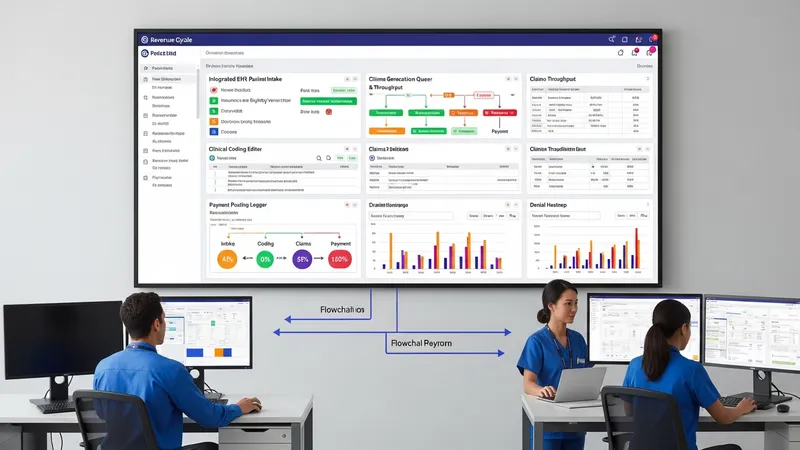
- Patient registration and insurance verification modules — capture demographic data, perform eligibility checks, and often integrate with external payor directories to validate coverage status.
- Clinical coding and charge capture systems — assist clinicians and coders in translating documentation into standardized code sets used for billing, and aggregate charges for claim creation.
- Claims management and denial tracking tools — create and submit claims electronically, monitor adjudication outcomes, flag denials, and support appeals workflows and root-cause analysis.
Integration between registration, coding, and claims modules may reduce transcription errors and speed claim submission. For example, when patient demographics flow automatically from registration into coding and billing modules, the likelihood of mismatched identifiers may decline. Systems that include pre-submission scrubbers can identify commonly rejected fields and prompt corrections before sending claims. These patterns often translate into shorter accounts receivable cycles and clearer operational metrics, although results will vary with implementation and organizational processes.
Automation features such as eligibility verification APIs and rules-based coding checks can shift routine tasks away from manual processing, which may help teams focus on complex cases and appeals. Automation typically requires configuration to match local payer rules and clinical workflows. Organizations may find that iterative tuning—adjusting scrubber thresholds, updating code sets, and refining mapping rules—can be necessary to align system behavior with payer expectations and local billing practices.
Denial management workflows within RCM software commonly include categorization, assignment, and tracking of appeals. Effective denial tracking often depends on consistent coding, timely documentation, and clear handoffs between clinical and billing staff. Analytics that surface denial trends by payer, procedure, or practitioner can support targeted interventions, such as coder training or documentation improvement initiatives. These interventions may reduce repeat denials over time when combined with process changes and feedback loops.
Data security and regulatory alignment are integral parts of RCM implementations. Software may offer role-based access controls, encryption in transit and at rest, and audit logs that record user actions. Compliance modules often include features to help manage payer rules, support audits, and maintain appropriate documentation retention. Organizations typically consider these capabilities alongside operational needs to ensure that billing workflows both protect patient data and satisfy regulatory expectations.
In summary, RCM software for hospitals and clinics encompasses modules for registration, coding, claims, payments, denials, and analytics, with an emphasis on integration and workflow support. Implementations may vary by facility size, specialty, and local payer landscapes; therefore, assessing module interoperability, configurability, and data protection features is often useful. The next sections examine practical components and considerations in more detail.