
Fiber Internet: Understanding Service Options And Connection Types

Fiber-optic broadband uses thin strands of glass or plastic to transmit data as pulses of light. This physical medium often replaces or supplements copper lines to carry large volumes of data with low electrical interference. Service offerings vary by how close the fiber terminates to the end user and by the networking architecture used at the provider’s core. Understanding those distinctions helps clarify why some installations deliver symmetric upload and download speeds while others combine fiber with existing copper or coaxial segments.
Providers typically describe networks by the point where fiber ends relative to a building or household: directly to the residence, to a building distribution point, to a neighborhood cabinet, or to a node further away. The underlying optical technologies—such as shared passive optical networks or dedicated active fiber—may affect bandwidth sharing, latency, and equipment needs. Service terms, installation complexity, and equipment responsibilities also often differ according to the connection type and architecture chosen.
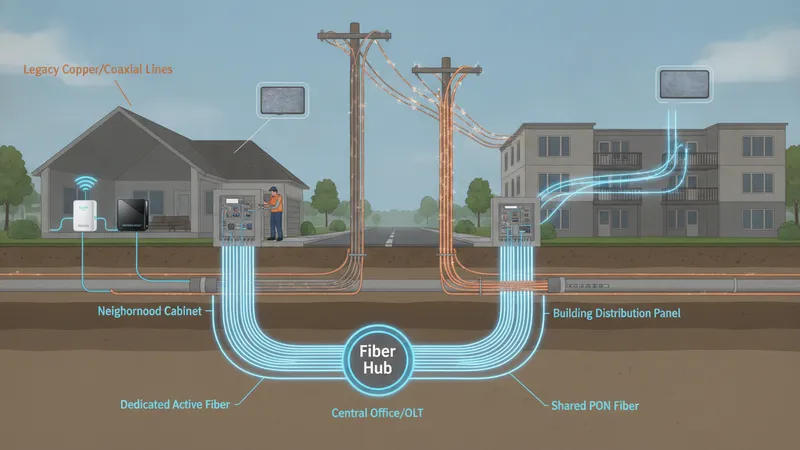
- FTTH / FTTP (Fiber to the Home / Premises): a fiber line that reaches individual residences or business premises, with an optical network termination device installed on site to convert light signals to Ethernet.
- FTTB (Fiber to the Building): fiber runs to a multi-dwelling or multi-tenant building’s communications room, with internal wiring (copper or Ethernet) distributing service to units.
- FTTC / FTTN (Fiber to the Cabinet / Node): fiber terminates at a street cabinet or neighborhood node; remaining distance to premises often uses existing copper or coaxial cabling.
- Network architectures (Passive Optical Network vs Active Ethernet): PON shares fiber capacity across multiple endpoints using splitters, while active Ethernet uses dedicated fiber strands to each endpoint and active switches in the network.
Comparing these examples, FTTH/FTTP often provides the simplest path to high symmetrical bandwidth because fiber extends to the premises and uses an optical network terminal there. FTTB may deliver similar optical capacity to a building but rely on in-building wiring that can affect achievable rates at individual units. FTTC and FTTN typically make use of legacy copper or coax for the last leg, which can impose distance-related attenuation and lower upload capacity. The choice of architecture may influence whether a service plan advertises symmetrical or asymmetric bandwidth.
The contrast between PON and active Ethernet architectures can be informative for technical planning. PON implementations use optical splitters to share a single fiber upstream across multiple subscribers, which may mean shared upstream or downstream capacity during busy periods. Active Ethernet provides a dedicated fiber path per endpoint but requires powered equipment and switch infrastructure in the provider’s network. Each approach may lead to different operational costs and maintenance arrangements for the operator and different performance profiles for end users.
Installation and customer premises equipment also vary by connection type. FTTH typically requires an optical network terminal (ONT) mounted at the premises and a router to create a local network; the ONT may be customer-owned or provider-supplied under a service agreement. For FTTB, a building aggregation device may be installed in a communications closet, and individual units connect via existing copper or structured cabling. For FTTC/FTTN, technician visits often focus on the cabinet and the transition from fiber to copper. Installation timelines and on-site access requirements can differ accordingly.
Service terms such as bandwidth tiers, data usage policies, and contract length may be tied to the physical connection and architecture. Providers may offer plans with gigabit-class downstream speeds for FTTH deployments and more limited upload rates or data allowances where copper remains in the last segment. Pricing structures often reflect installation complexity and equipment provisioning. When assessing options, it can be useful to compare technical and contractual elements together rather than relying on a single metric.
In summary, variants of fiber deployment differ by where optical fiber terminates (home, building, cabinet, or node) and by whether the network uses shared or dedicated fiber architecture. These distinctions typically influence achievable speeds, latency, equipment needs, and installation requirements. The next sections examine practical components and considerations in more detail.