
Fall Alert For Seniors: How Personal Alert Systems Work At Home And Outdoors

Personal alert systems for seniors are technologies and services designed to let an individual request help after a fall or during other emergencies, both inside the home and when away from it. These systems typically combine a wearable component (such as a pendant, wristband, or clip), sensors that may detect sudden movement patterns, and a communication pathway that connects the user to responders or designated contacts. The goal is to shorten the time between an incident and a response by providing a straightforward means to signal for assistance and to supply location or context when available.
Functionally, these systems vary by how they detect incidents and how they reach help. Some devices rely on a manual emergency button that the wearer presses; others include automatic fall-detection algorithms based on accelerometers and gyroscopes. Communication can use a dedicated home base station, a cellular radio inside the wearable, or a paired smartphone as the relay. Response pathways may send an alert to a monitoring service, to a list of personal contacts, or to local emergency services depending on configuration and local regulations.
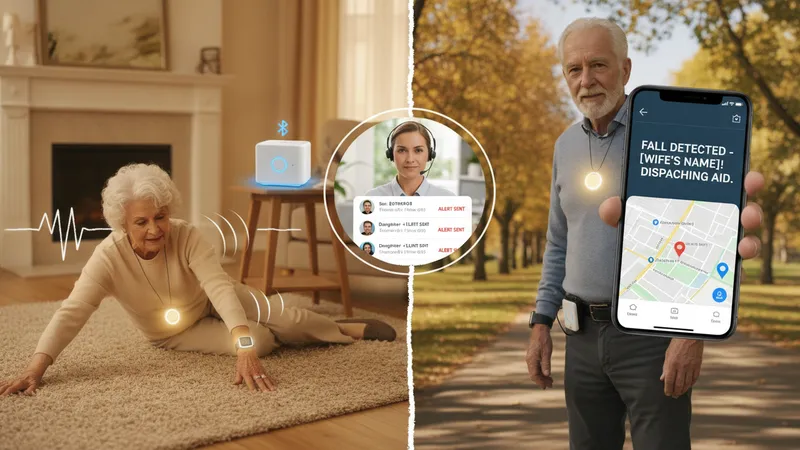
- Wearable emergency pendant or button — a small wireless device worn on the neck or wrist that sends an alert when the user presses a button; often used with a home base station or paired smartphone.
- Automatic fall-detection wearable (watch or band) — devices that use motion sensors and algorithms to flag sudden impacts or atypical motion patterns and trigger an alert with or without manual confirmation.
- Smartphone-based emergency app with GPS — applications that enable one-tap alerts and continuous location sharing when the phone has connectivity; these can supplement dedicated wearables for outdoor use.
Comparisons among these example approaches often center on detection method, range, and dependence on other equipment. Manual-button systems typically have simple operation and may be reliable when the user can press the device, but they require the wearer to be conscious and reachable. Automatic fall detection may catch incidents when the user cannot press a button, yet sensitivity settings and algorithm quality can affect false alarms; adjustments may be needed to balance missed events and false positives. Smartphone-based solutions provide GPS location outdoors but rely on cellular or data connectivity and the user keeping the phone on their person.
Range and environment are important technical considerations. Home base stations can work across much of a residence using low-power radio, but their effective distance depends on floor plan and building materials. Wearables with built-in cellular radios extend outdoor coverage but depend on cellular network availability and signal strength. Bluetooth-reliant devices typically need to remain close to a paired phone or base unit. In many contexts, users combine devices to cover both indoor convenience and outdoor mobility.
Monitoring and response pathways differ by model and service. Some setups route alerts to a professional monitoring center that follows an escalation protocol—attempting two-way voice communication and contacting emergency services when necessary—while others notify personal emergency contacts first. Privacy and consent are relevant: systems that share continuous location or health-related motion data should have clear account settings and consent options. Users and caregivers often weigh preferences about who receives alerts and how escalation should proceed.
Maintenance, testing, and reliability are routine practical matters. Battery life varies by device type and usage pattern; many wearables include low-battery alerts and recommend periodic testing. Firmware updates and occasional device resets may be necessary to maintain accurate detection and reliable communication. Training the user and household members on device operation, periodic drills for test alerts, and confirming contact lists can support consistent performance without assuming infallible behavior by any single component.
In summary, personal alert systems for seniors combine wearables, sensors, communications, and response workflows to provide a means of requesting help after a fall or other emergency. Choices among manual-button devices, automatic fall-detection wearables, and smartphone-based solutions involve trade-offs in detection accuracy, range, dependency on other equipment, and the route by which alerts are delivered. The next sections examine practical components and considerations in more detail.