
Digital Twin Transformation In Healthcare: Understanding Provider Roles And Capabilities

A digital twin in clinical contexts is a computational representation of a real-world healthcare element—such as a medical device, a care pathway, or an aggregated patient data environment—that mirrors state and behavior so that stakeholders can examine scenarios, monitor performance, and explore options without interacting with the physical system. These models combine data streams from electronic health records, imaging, device telemetry, and environmental sensors with simulation algorithms. In practice, the virtual replica may update in near real time and can be used to visualize processes, test configuration changes, or support operational planning within a provider organization.
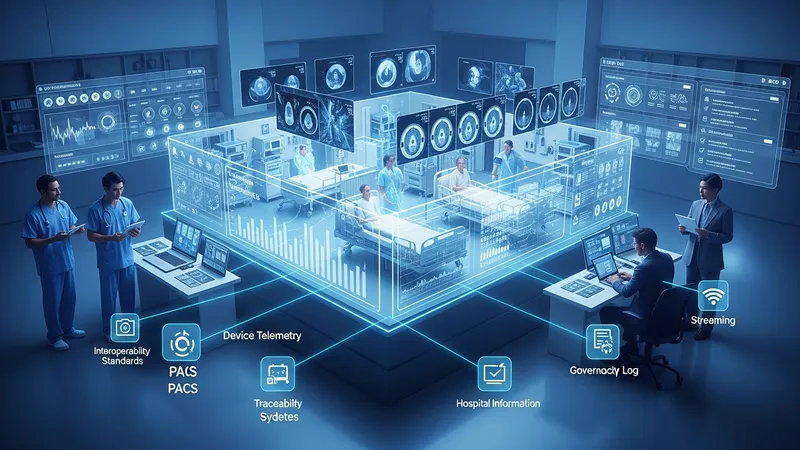
Implementations typically involve collaboration among clinicians, IT staff, biomedical engineers, and external platform providers. In the United States, projects often connect digital twins to hospital information systems, picture archiving and communication systems, and device management platforms so the virtual model reflects clinical workflows and regulatory requirements. Data harmonization and traceability are frequent priorities, and teams may adopt interoperability standards and defined governance to ensure the twin aligns with clinical and operational objectives without making clinical recommendations directly from the model.
- Microsoft Azure Digital Twins — a cloud-based modeling service that can represent physical spaces, devices, and data relationships for healthcare facility and device simulations.
- NVIDIA Clara — a set of developer tools and frameworks for medical imaging, inference, and simulation that can support patient-specific modeling and workload acceleration on compatible hardware.
- Siemens Healthineers digital solutions (U.S.) — vendor offerings that include simulation and device lifecycle tools intended to integrate with clinical imaging and operational systems.
Comparatively, these examples illustrate different technical emphases: cloud-native graph modeling, accelerated medical imaging and AI workloads, and vendor-integrated device and imaging simulations. Selection among such options may depend on whether a provider seeks facility-level operational simulation, patient-specific modeling, or device lifecycle management. Cost structures typically vary by scale and integration needs and may include cloud consumption, software licenses, and engineering services. Teams often evaluate integration overhead, data residency, and compatibility with local electronic health records when determining architecture.
Operationally, providers may use digital twins to examine scheduling, capacity planning, and equipment maintenance scenarios without disrupting care delivery. For instance, a hospital might simulate alternate staffing patterns or imaging workflows to estimate impacts on throughput. These simulations may rely on historical EHR timestamps, operational logs, and device telemetry. When applied cautiously, the process can surface workflow bottlenecks and support planning; outcomes reported in project studies often describe potential efficiencies rather than guaranteed improvements.
From a clinical perspective, patient-specific twins can combine imaging, physiology, and monitored signals to create individualized computational models that support planning or training. Such models often require high-fidelity inputs—imaging resolution, sensor calibration, and validated physiological submodels—to be useful for simulation. In the United States, academic medical centers may publish pilot studies demonstrating feasibility for particular applications, though these studies typically emphasize research contexts and technical validation rather than established clinical practice changes.
Data governance and interoperability are central considerations. Providers commonly adopt standards such as HL7 FHIR to exchange structured clinical data and may use vendor APIs to ingest device telemetry. Privacy protections, de-identification, and role-based access control are typical elements of governance models, especially when research or multi-institutional collaboration is involved. Teams often implement logging and validation routines so that model inputs and outputs remain auditable for operational review and regulatory scrutiny where applicable.
In summary, creating virtual replicas of clinical systems or patient data environments involves technical modeling, multidisciplinary collaboration, and attention to data governance and integration. Implementations in U.S. healthcare settings may draw on cloud platforms, vendor tools, and standards-based interfaces to align virtual models with operational and clinical workflows. The next sections examine practical components and considerations in more detail.